
Threat Intelligence Blog
Contact us to discuss any insights from our Blog, and how we can support you in a tailored threat intelligence report.

Our latest piece in the Guernsey Press - The new GFSC Cyber Security Rules: What the GFSC demands of firms, and why leaving it all to your IT provider won't make you compliant
Our latest piece in the Guernsey Press - The new GFSC Cyber Security Rules: What the GFSC demands of firms, and why leaving it all to your IT provider won't make you compliant

New Cyber Rules just released by the GFSC - and how Black Arrow can help you become compliant
Welcome to this week's Black Arrow Cyber Tip Tuesday, this week Tony is talking about the new cyber rules that the GFSC have just released and which are now in force for regulated financial services firms in the Bailiwick.
The GFSC have now released the new cyber rules and all regulated financial will need to be able to demonstrate compliance with these new regulations.
The regulations are built around compliance or adherence to the internationally recognised NIST cyber security framework and the five pillars contained therein, being identify, protect, detect, respond and recover.
We can assist any firm by producing a gap analysis against the NIST standard, and therefore the GFSC rules, to identify any areas of non-compliance or areas where firms will need to bolster their existing security arrangements.
Remember that cyber and information encompasses a lot more than just IT but is rather requires a holistic approach across people, operations and technology.
Leaving this solely to your IT team or IT provider likely won’t provide the coverage the GFSC now expects from firms.
Remember too taking a proactive approach should always be about preventing an attack or breach, many firms do not survive a significant cyber event, and for those that do recovery invariably costs a lot more than it would have cost to put appropriate controls in place to prevent the breach happening in the first place.
Boards are expected to show good governance over cyber and information security as they would be expected to do with any older and longer established risks.
It is clear from the new rules that the GFSC also agree that the responsibility for cyber and information security clearly sits with Boards, not IT.
Talk to us today to see how we can help you demonstrate compliance or become compliant with the new GFSC cyber rules.
Welcome to this week's Black Arrow Cyber Tip Tuesday, this week Tony is talking about the new cyber rules that the GFSC have just released and which are now in force for regulated financial services firms in the Bailiwick.
The GFSC have now released the new cyber rules and all regulated financial will need to be able to demonstrate compliance with these new regulations.
The regulations are built around compliance or adherence to the internationally recognised NIST cyber security framework and the five pillars contained therein, being identify, protect, detect, respond and recover.
We can assist any firm by producing a gap analysis against the NIST standard, and therefore the GFSC rules, to identify any areas of non-compliance or areas where firms will need to bolster their existing security arrangements.
Remember that cyber and information encompasses a lot more than just IT but is rather requires a holistic approach across people, operations and technology.
Leaving this solely to your IT team or IT provider likely won’t provide the coverage the GFSC now expects from firms.
Remember too taking a proactive approach should always be about preventing an attack or breach, many firms do not survive a significant cyber event, and for those that do recovery invariably costs a lot more than it would have cost to put appropriate controls in place to prevent the breach happening in the first place.
Boards are expected to show good governance over cyber and information security as they would be expected to do with any older and longer established risks.
It is clear from the new rules that the GFSC also agree that the responsibility for cyber and information security clearly sits with Boards, not IT.
Talk to us today to see how we can help you demonstrate compliance or become compliant with the new GFSC cyber rules.

Black Arrow Cyber Threat Briefing 12 February 2021
Welcome to this week’s Black Arrow Cyber Threat Briefing – a weekly digest, collated and curated by our cyber experts to provide senior and middle management with an easy to digest round up of the most notable threats, vulnerabilities and cyber related news from the last week.

Top Cyber Stories of the Last Week
2020 Sees Ransomware Increase By Over 400 Percent
A new study from Cyber Security company, finds that last year malware increased by 358 percent overall and ransomware increased by 435 percent as compared with 2019. The report which analyzes millions of attacks taking place across the year finds distribution of the Emotet malware skyrocketed by 4,000 percent, while malware threats attacking Android phones increased by 263 percent. July saw the largest increase in malicious activity, up by 653 percent compared with the previous year. Microsoft Office documents are the most manipulated document attack vector and these attacks were up by 112 percent.
https://betanews.com/2021/02/10/ransomware-increase-400-percent/
Remote Desktop Protocol Attacks Surge By 768%
Remote desktop protocol (RDP) attacks increase by 768% between Q1 and Q4 last year, fuelled by the shift to remote working. However, a slower rate of growth was observed in the final quarter of the year, indicating that organizations have enhanced their security for remote users.
https://www.infosecurity-magazine.com/news/remote-desktop-protocol-attacks/
Even Minor Phishing Operations Can Distribute Millions Of Malicious Emails Per Week
Even small-scale phishing campaigns are capable of distributing millions and millions of malicious emails to victims around the world, according to a new report. Describing the most popular styles of phishing attack, criminal today rely on fast-churning campaigns. They create a single phishing email template (usually in English) and send it out to anywhere between 100 and 1,000 targets.
With One Update, This Malicious Android App Hijacked Millions Of Devices
With a single update, a popular barcode scanner app on Google Play transformed into malware and was able to hijack up to 10 million devices. Lavabird Ltd.'s Barcode Scanner was an Android app that had been available on Google's official app repository for years. The app, accounting for over 10 million installs, offered a QR code reader and a barcode generator -- a useful utility for mobile devices.
Cd Projekt Hit By Ransomware Attack, Refused To Pay Ransom, Data Reportedly Sold Off By Hackers
Polish video game maker CD Projekt, which makes Cyberpunk 2077 and The Witcher, has confirmed it was hit by a ransomware attack. In a statement posted to its Twitter account, the company said it will “not give in nor negotiate” with the hackers, saying it has backups in place. “We have already secured our IT infrastructure and begun restoring data,” the company said.
https://techcrunch.com/2021/02/09/cd-projekt-red-hit-by-ransomware-attack-refuses-to-pay-ransom/
Hacked Florida Water Plant Used Shared Passwords And Windows 7 PCs
The Oldsmar, Florida water plant hacked earlier this week used outdated Windows 7 PCs and shared passwords, the Associated Press has reported. A government advisory also revealed that the relatively unsophisticated attack used the remote-access program TeamViewer. However, officials also said that the hacker’s attempt to boost chemicals to dangerous levels was stopped almost immediately after it started.
Top Web Hosting Provider Shuts Down Following Cyber Attack
Cybercriminals often attack websites in order to extort a ransom from their victims but a recent cyberattack against the web hosting company No Support Linux Hosting took quite a different turn. After a hacker managed to breach the company's internal systems and compromise its entire operation, No Support Linux Hosting has announced that it is shutting down. The company alerted its customers to the situation before shutting down its website in a message.
https://www.techradar.com/news/top-web-hosting-provider-shuts-down-following-cyberattack
High Demand For Hacker Services On Dark Web Forums
Nine in 10 (90%) users of dark web forums are searching for a hacker who can provide them with a particular resource or who can download a user database. This is according to new research by Positive Technologies, which analyzed activity on the 10 most prominent forums on the dark web, which offer services such as website hacking and the buying/selling of databases. The study highlights the growing demand for hackers’ services and stolen data, exacerbated by the increased internet usage by both organizations and individuals since the start of COVID-19.
https://www.infosecurity-magazine.com/news/demand-hacker-services-dark-web/
Facebook Phishing Campaign Tricked Nearly 500,000 Users In Two Weeks
A recent investigation uncovered a large scale phishing operation on Facebook. The Facebook phishing campaign is dangerous and targets user personal information. The phishing scam “Is that you” currently on Facebook has been around in multiple forms for years. The whole trouble starts with a “friend” sending you a message claiming to have found a video or image with you in it. The message is usually a video and after clicking, it takes you through a series of websites. These websites have malicious scripts that get your location, device type, and operating system.
Hackers Are Tweaking Their Approach To Phishing Attacks In 2021
Cyber criminals are a creative bunch, constantly coming up with new ways to avoid detection and advance their sinister goals. A new report from cyber security experts at BitDam describes a few fresh techniques used in the wild so far in 2021. According to the report, email protection solutions tend to trust newly created email domains that are yet to be flagged as dangerous. Criminals are now increasingly exploiting this fact to increase the chances that phishing, and malware emails make it into victims' inboxes.
https://www.itproportal.com/news/hackers-are-tweaking-their-approach-to-phishing-attacks-in-2021/
Threats
Ransomware
Researchers identify 223 vulnerabilities used in recent ransomware attacks (Potential headline)
This old form of ransomware has returned with new tricks and new targets
Phishing
Malware
Mobile
IOT
Vulnerabilities
Attackers Exploit Critical Adobe Flaw to Target Windows Users
Microsoft issues emergency fix for Wi-Fi foul-up delivered hot and fresh on Patch Tuesday
Data Breaches
Organised Crime
Supply Chain
Nation-State Actors
Android spyware strains linked to state-sponsored Confucius threat group
'BendyBear' APT malware linked to Chinese government hackers
Microsoft to alert Office 365 users of nation-state hacking activity
Privacy
Reports Published in the Last Week
As usual, contact us to help assess where your risks lie and to ensure you are doing all you can do to keep you and your business secure.
Look out for our weekly ‘Cyber Tip Tuesday’ video blog and on our YouTube channel.
You can also follow us on Facebook, Twitter and LinkedIn.
Links to articles are for interest and awareness and linking to or reposting external content does not endorse any service or product, likewise we are not responsible for the security of external links.

Black Arrow Cyber Threat Briefing 05 February 2021
Black Arrow Cyber Threat Briefing 05 February 2021: Ransomware Gangs Made At Least $350 Million In 2020; Widening Security Shaped Gulf Between Firms And Remote Workers; 3.2 Billion Emails And Passwords Exposed; Account Takeover and Data Leakage Attacks Spiked In 2020; Automated Tools Increasingly Used to Launch Cyber Attacks; 93% Of Workers Overshare Online, Causing Social Engineering Risks;
Welcome to this week’s Black Arrow Cyber Threat Briefing – a weekly digest, collated and curated by our cyber experts to provide senior and middle management with an easy to digest round up of the most notable threats, vulnerabilities and cyber related news from the last week.

Photo by Corinne Kutz on Unsplash
Top Cyber Stories of the Last Week
Ransomware Gangs Made At Least $350 Million In 2020
Ransomware gangs made at least $350 million in ransom payments last year, in 2020, blockchain analysis. The figure was compiled by tracking transactions to blockchain addresses linked to ransomware attacks. Although Chainalysis possesses one of the most complete sets of data on cryptocurrency-related cybercrime, the company said its estimate was only a lower bound of the true total due.
https://www.zdnet.com/article/ransomware-gangs-made-at-least-350-million-in-2020/
Home Working Increases Cyber Security Fears
"We see tens of different hacking attacks every single week. It is never ending."A senior computer network manager says they are bombarded from all directions. "We see everything," he says. "Staff get emails sent to them pretending to be from the service desk, asking them to reset their log-in passwords. "We see workers being tricked into downloading viruses from hackers demanding ransoms, and we have even had employees sent WhatsApp messages pretending to be from the CEO, asking for money transfers.
https://www.bbc.co.uk/news/business-55824139
3.2 Billion Emails And Passwords Exposed Online
A whopping 3.2 billion password-username pairs are up for grabs in an unnamed online hacking forum. But don't panic — the data is nothing new. It's a compilation of stolen credentials from dozens of old data breaches, some going back ten years. That doesn't mean you shouldn't be aware that your old passwords are floating out there. Yes, your passwords, and ours too. Pretty much anyone who's ever created more than three online accounts has had a password compromised by now.
https://www.tomsguide.com/news/3-2-billion-passwords-leaked
Account Takeover Attacks Spiked In 2020
Occurring whenever a bad actor can steal login credentials and seize control of an online account, takeover attacks rose from 34% of fraud detected in 2019 to 54% by the end of December 2020. Other methods of fraud were blips on the radar compared to account takeovers: The next most popular method, at just 16% of detected fraud, was money laundering/mule transactions, followed by new account fraud (14%), and a mere 12% of instances used remote access or hacking tools to accomplish their goals.
https://www.techrepublic.com/article/account-takeover-attacks-spiked-in-2020-kaspersky-says/
30% Of “Solarwinds Hack” Victims Didn’t Actually Use Solarwinds
When security last week that it had been targeted by the same attacker that compromised SolarWinds' Orion software, it noted that the attack did not use SolarWinds itself. According to Malwarebytes, the attacker had used "another intrusion vector" to gain access to a limited subset of nearly a third of the organizations attacked had no direct connection to SolarWinds.
Data Leakage Attacks Saw Huge Rise In 2020
The number of data leakage incidents grew by an “unprecedented” rate in 2020, a new report from Imperva argues. Through online means alone, not counting leaks caused by lost hardware or word of mouth, Imperva researchers tracked a 93 percent rise. By the end of the year, Imperva had identified a total of 1.7 million leaks, with the the number growing even faster in the second half of the year. Between Q3 and Q4, there was a 47 percent increase.
https://www.itproportal.com/news/data-leakage-attacks-saw-huge-rise-in-2020/
Automated Tools Increasingly Used to Launch Cyber Attacks
Cyber-criminals are increasingly making use of automation and bots to launch attacks, according to a new analysis. revealed that over half (54%) of all cyber-attacks it blocked in November and December were web application attacks which involved the use of automated tools. The most prevalent form was fuzzing attacks, making up around one in five (19.5%). This uses automation to detect and exploit the points at which applications break. This was followed by injection attacks (12%), in which cyber-criminals make use of automation tools such as sqlmap to gain access to applications.
https://www.infosecurity-magazine.com/news/automated-tools-launch-cyber/
A Second SolarWinds Hack Deepens Third-Party Software Fears
It’s been more than two months since revelations that alleged Russia-backed hackers broke into the IT management firm SolarWinds and used that access to launch a massive software supply chain attack. It now appears that Russia was not alone; Reuters reports that suspected Chinese hackers independently exploited a different flaw in SolarWinds products last year at around the same time, apparently hitting the US Department of Agriculture's National Finance Center.
https://www.wired.com/story/solarwinds-hack-china-usda/
93% Of Workers Overshare Online, Causing Security Risks
Reveals just how much, and how often, people divulge about their lives online and how attackers take advantage of it. With insights from both professionals and hackers, the report explores how cybercriminals use an abundant and seemingly cheap resource — the personal information people share on social media and in out-of-office alerts — to craft social engineering attacks.
https://www.helpnetsecurity.com/2021/02/03/workers-overshare-online/
Is There A Widening Gulf Between You And Your Remote Workers? Yes – And It’s Security Shaped
It’s been almost a year since large parts of the workforce beat a hasty retreat from their offices, and began a mass experiment in working from home, often courtesy of Microsoft 365. And after 12 or so months, it’s safe to say that the case for productive remote working has been proved, and that many workers will continue to do so even when the all clear sounds. But is there a question as to whether remote working is as secure as the traditional, office bound, hard perimeter setup? Well, yes, and it’s fair to say the jury is still very much out.
https://www.theregister.com/2021/02/04/mind_the_security_gap_regcast/
Threats
Ransomware
Blockchain Analysis Shows Connections Between Four of 2020’s Biggest Ransomware Strains
2021's First Big Ransomware Gang Launches Sleek and Bigoted 'Leak' Site
Ransomware gangs now have industrial targets in their sights. That raises the stakes for everyone
Other Social Engineering
Malware
This malware abuses Tor and Telegram infrastructure to evade detection
Tiny Kobalos malware seen backdooring SSH tools, menacing supercomputers, an ISP, and more – ESET
Experts discovered a new Trickbot module used for lateral movement
Agent Tesla ramps up its game in bypassing security walls, attacks endpoint protection
Mobile
Vulnerabilities
Data Breaches
Security firm Stormshield discloses data breach, theft of source code
Female escort review site data breach affects 470,000 members
Nation-State Actors
As usual, contact us to help assess where your risks lie and to ensure you are doing all you can do to keep you and your business secure.
Look out for our weekly ‘Cyber Tip Tuesday’ video blog and on our YouTube channel.
You can also follow us on Facebook, Twitter and LinkedIn.
Links to articles are for interest and awareness and linking to or reposting external content does not endorse any service or product, likewise we are not responsible for the security of external links.
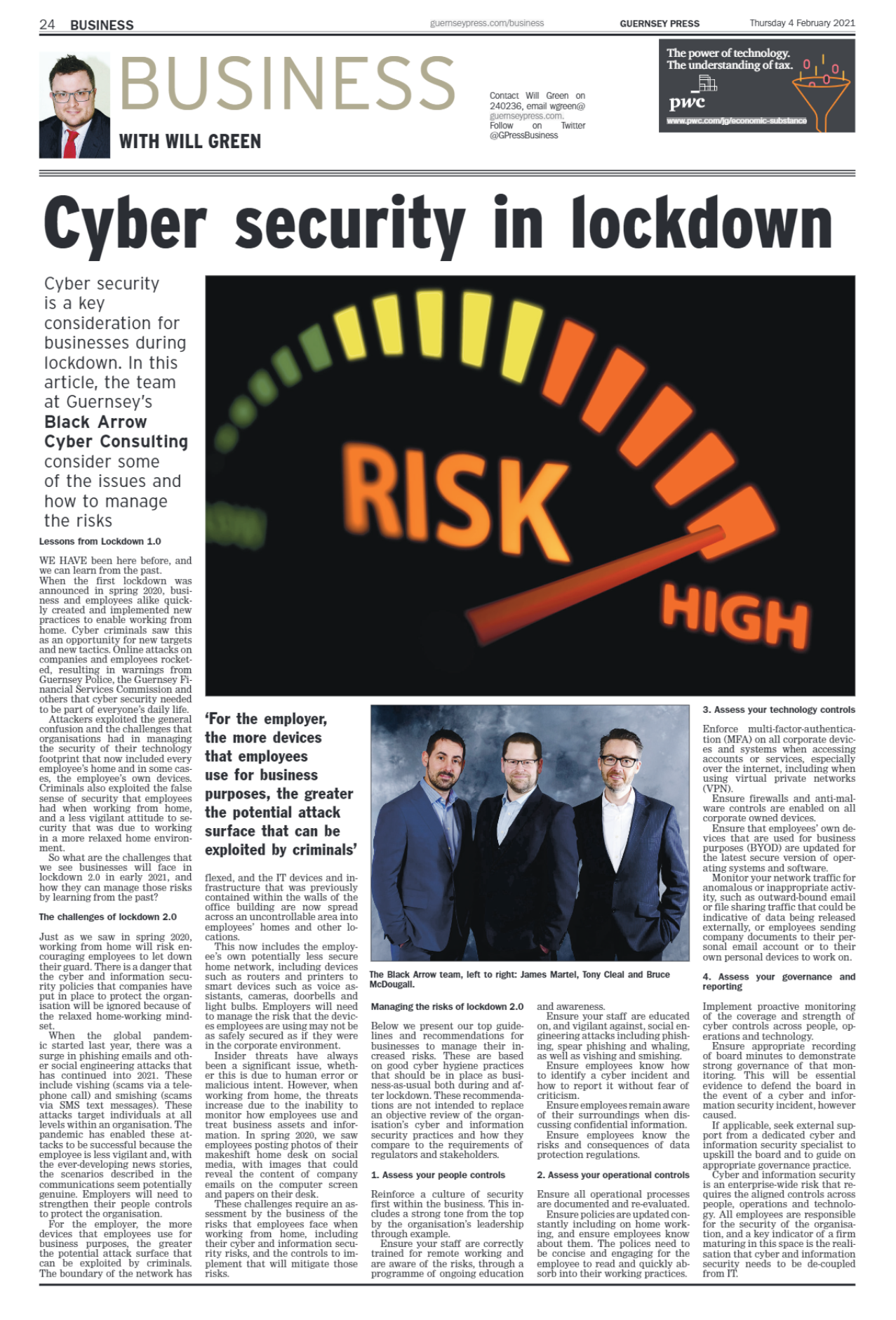
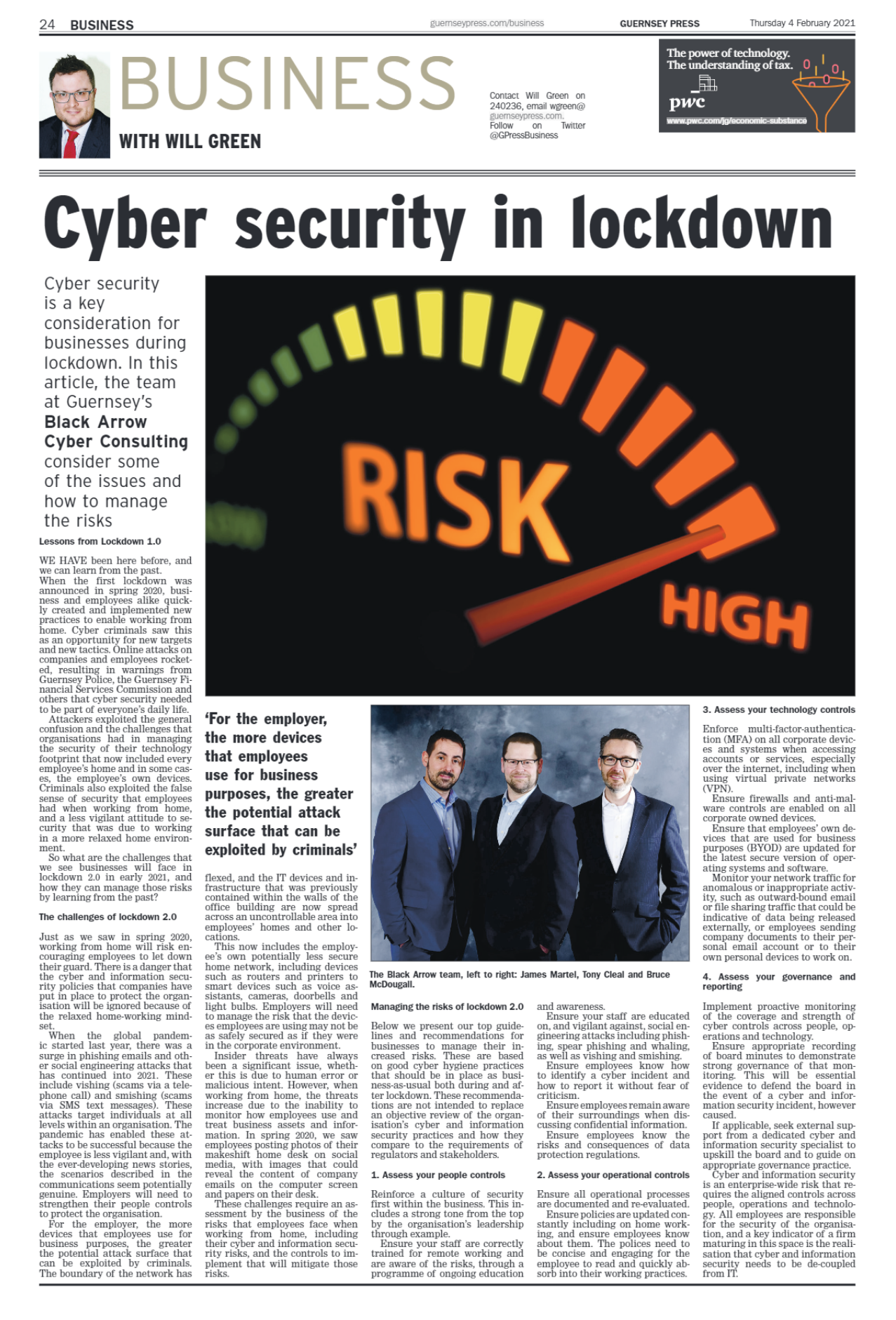
Cyber Security Guidance for Firms during Lockdown 2.0 - What Should Firms Be Doing? Guernsey Press 04 February 2020
Cyber Security is a key consideration for businesses during lockdown. In this article, the team from Guernsey’s Black Arrow Cyber Consulting consider some the issues and how to manage the risks

Black Arrow Cyber Threat Briefing 29 January 2021
Black Arrow Cyber Threat Briefing 29 January 2021: Phishing Attacks Show High-Ranking Execs ‘Most Valuable Asset’ and ‘Greatest Vulnerability’; Paying Ransomware Funding Organised Crime; Police take down botnet that hacked millions of computers; After SolarWinds Hack, Who Knows What Cyber Dangers We Face; Russian businesses warned of retaliatory cyber attacks; iOS vulns actively exploited; Top Cyber Attacks of 2020
Welcome to this week’s Black Arrow Cyber Threat Briefing – a weekly digest, collated and curated by our cyber experts to provide senior and middle management with an easy to digest round up of the most notable threats, vulnerabilities and cyber related news from the last week.

Top Cyber Headlines of the Week
Phishing Attacks Show High-Ranking Execs May Be ‘Most Valuable Asset,’ and ‘Greatest Vulnerability’
Cyber criminals have been using a phishing kit featuring fake Office 365 password alerts as a lure to target the credentials of chief executives, business owners and other high-level corporate leaders. The scheme highlights the role and responsibility upper management plays in ensuring the security of their own company’s assets.
Insurers 'Funding Organised Crime' by Paying Ransomware Claims
Insurers are inadvertently funding organised crime by paying out claims from companies who have paid ransoms to regain access to data and systems after a hacking attack, Britain’s former top cybersecurity official has warned.
Emotet: Police raids take down botnet that hacked 'millions of computers worldwide'
Emotet, one of the world's most dangerous cyber crime services, has been taken down following one of the largest ever internationally-coordinated actions against cyber criminals. Although it began as banking malware designed to steal financial credentials, Emotet had become an infrastructure tool leased out to cyber criminals to break into victim computer networks and install additional malicious software.
After the SolarWinds Hack, We Have No Idea What Cyber Dangers We Face
Months before insurgents breached the Capitol and rampaged through the halls of Congress, a stealthier invader was muscling its way into the computers of government officials, stealing documents, monitoring e-mails, and setting traps for future incursions. Last March, a hacking team, believed to be affiliated with Russian intelligence, planted malware in a routine software upgrade from a Texas-based I.T. company called SolarWinds, which provides network-management systems to more than three hundred thousand clients.
FSB warns Russian businesses of cyber attacks as retaliation for SolarWinds hack
Russian authorities are alerting Russian organizations of potential cyberattacks launched by the United States in response to SolarWinds attack. The Russian intelligence agency FSB has issued a security alert this week warning Russian organizations of potential cyberattacks launched by the United States in response to the SolarWinds supply chain attack.
Update your iPhone — Apple just disclosed hackers may have 'actively exploited' a vulnerability in its iOS
On Tuesday released a new iOS software update that includes fixes for three security weaknesses in the former version. Its support website that it is aware of the three security bugs and that they "may have been actively exploited. “Also, it does not disclose details regarding security issues "until an investigation has occurred."
Top Cyber Attacks of 2020
"Zoombomb" became the new photobomb—hackers would gain access to a private meeting or online class hosted on Zoom and shout profanities and racial slurs or flash pornographic images. Nation-state hacker groups mounted attacks against organisations involved in the coronavirus pandemic response, including the World Health Organization and Centres for Disease Control and Prevention, some in an attempt to politicize the pandemic.
https://thehackernews.com/2021/01/top-cyber-attacks-of-2020.html
Threats
Ransomware
Cyber Criminals use deceased staff accounts to spread Nemty ransomware
US and Bulgarian authorities disrupt NetWalker ransomware operation
Former UK Cyber Security Chief Says Laws Are Needed to Stop Ransomware Payouts
BEC
Phishing
Other Social Engineering
Malware
DreamBus botnet targets enterprise apps running on Linux servers
Trickbot is back again - with fresh phishing and malware attacks
Mobile
Vulnerabilities
Heap-based buffer overflow in Linux Sudo allows local users to gain root privileges
Vulnerability found in top messaging apps let hackers eavesdrop
Experts Detail A Recent Remotely Exploitable Windows Vulnerability
Former LulzSec Hacker Releases VPN Exploit Used to Hack Hacking Team
KindleDrip exploit – Hacking a Kindle device with a simple email
Data Breaches
Charities
Insider Threats
Nation-State Actors
Denial of Service
Privacy
Reports Published in the Last Week
As usual, contact us to help assess where your risks lie and to ensure you are doing all you can do to keep you and your business secure.
Look out for our weekly ‘Cyber Tip Tuesday’ video blog and on our YouTube channel.
You can also follow us on Facebook, Twitter and LinkedIn.
Links to articles are for interest and awareness and linking to or reposting external content does not endorse any service or product, likewise we are not responsible for the security of external links.
Top Tips for Guernsey Businesses During the Second Coronavirus Lockdown, Cyber Tip Tuesday
Top Tips for Guernsey Businesses During the Second Coronavirus Lockdown, Cyber Tip Tuesday 26 January 2021
Top Tips for Guernsey Businesses During the Second Coronavirus Lockdown, Cyber Tip Tuesday 26 January 2021

Black Arrow Cyber Threat Briefing 22 January 2021
Black Arrow Cyber Threat Briefing 22 January 2021: Ransomware Biggest Cyber Concern; Ransomware Payments Grew 311% In 2020; Cyber Security Spending To Soar In 2021; Ransomware Provides The Perfect Cover For Other Attacks; Gdpr Fines Skyrocket As Eu Gets Tough On Data Breaches; Popular Pdf Reader Has Database Of 77 Miliion Users Leaked Online; Malware Incidents On Remote Devices Increase
Welcome to this week’s Black Arrow Cyber Threat Briefing – a weekly digest, collated and curated by our cyber experts to provide senior and middle management with an easy to digest round up of the most notable threats, vulnerabilities and cyber related news from the last week.

Top Cyber Headlines of the Week
Ransomware is now the biggest Cyber Security concern for CISOs
Ransomware is the biggest cyber security concern facing businesses, according to those responsible for keeping organisations safe from hacking and cyberattacks. A survey of chief information security officers (CISOs) and chief security officers (CISOs found that ransomware is now viewed as the main cyber security threat to their organisation over the course of the next year. Almost half – 46% – of CISOs and CISOs surveyed said that ransomware or other forms of extortion by outsiders represents the biggest cyber security threat.
https://www.zdnet.com/article/ransomware-is-now-the-biggest-cybersecurity-concern-for-cisos/
Crypto ransomware payments grew 311% in 2020
Crypto payments associated with ransomware grew at least 311% in 2020. “Ransomware” refers to a category of malicious computer programs that force users into paying ransoms. Just 0.34% of all cryptocurrency transactions last year were criminal, down from 2.1% in 2019. But that number is bound to go up, said the firm.
https://decrypt.co/54648/crypto-crime-ransomware-chainalysis-report-2020
The SolarWinds hackers used tactics other groups will copy
One of the most chilling aspects of Russia's recent hacking spree—which breached numerous United States government agencies among other targets—was the successful use of a “supply chain attack” to gain tens of thousands of potential targets from a single compromise at the IT services firm SolarWinds. But this was not the only striking feature of the assault. After that initial foothold, the attackers bored deeper into their victims' networks with simple and elegant strategies. Now researchers are bracing for a surge in those techniques from other attackers.
https://www.wired.com/story/solarwinds-hacker-methods-copycats/
Global Cyber Security spending to soar in 2021
The worldwide cyber security market is set to grow by up to 10% this year to top $60bn, as the global economy slowly recovers from the pandemic. Double-digit growth from $54.7bn in 2020 would be its best-case scenario. However, even in the worst case, cyber security spending would reach 6.6%. That would factor in a deeper-than-anticipated economic impact from lockdowns, although the security market has proven to be remarkably resilient thus far to the pandemic-induced global economic crisis. That said, SMB spending was hit hard last year, along with certain sectors like hospitality, retail and transport.
https://www.infosecurity-magazine.com/news/global-cybersecurity-spending-to/
Cyber criminals publish more than 4,000 stolen Sepa files
Sepa rejected a ransom demand for the attack, which has been claimed by the international Conti ransomware group. Contracts, strategy documents and databases are among the 4,000 files released. The data has been put on the dark web - a part of the internet associated with criminality and only accessible through specialised software.
https://www.bbc.co.uk/news/uk-scotland-55757884
Ransomware provides the perfect cover for other attacks
Look at any list of security challenges that CISOs are most concerned about and you’ll consistently find ransomware on them. It’s no wonder: ransomware attacks cripple organizations due to the costs of downtime, recovery, regulatory penalties, and lost revenue. Unfortunately, cybercriminals have added an extra sting to these attacks: they are using ransomware as a smokescreen to divert security teams from other clandestine activities behind the scenes
https://www.helpnetsecurity.com/2021/01/21/ransomware-cover/
Popular PDF reader has database of 77 million users hacked and leaked online
A threat actor has leaked a 14 GB database online containing over 77 million records relating to thousands of users of the Nitro PDF reader software, with users' email addresses, full names, hashed passwords, company names, IP addresses, and other system-related information.
Ransomware victims that have backups are paying ransoms to stop hackers leaking their stolen data
Some organisations that fall victim to ransomware attacks are paying ransoms to cyber-criminal gangs despite being able to restore their own networks from backups, in order to prevent hackers publishing stolen data. Over the course of the past year, many of the most successful ransomware gangs have added an additional technique in an effort to coerce victims into paying ransoms after compromising their networks – publishing stolen data if a payment isn't received.
GDPR fines skyrocket as EU gets tough on data breaches
Europe’s new privacy protection regime has led to a surge in fines for bad actors, according to research published today. Law firm DLA Piper says that, since January 28th, 2020, the EU has issued around €158.5 million (around $192 million) in financial penalties. That’s a 39-percent increase on the previous 20-month period Piper examined in its report, published this time last year. And as well as the increased fines, the number of breach notifications has shot up by 19 percent across the same 12-month period.
https://www.engadget.com/gdpr-fines-dla-piper-report-144510440.html
Malware incidents on remote devices increase
Devices compromised by malware in 2020, 37% continued accessing corporate emails after being compromised and 11% continued accessing cloud storage, highlighting a need for organizations to better determine how to configure business tools to ensure fast and safe connectivity for all users in 2021.
https://www.helpnetsecurity.com/2021/01/18/malware-incidents-remote-devices/
Threats
Phishing
Malware
Vulnerabilities
Signal and other video chat apps found to have some major security flaws
Automated exploit of critical SAP SolMan vulnerability detected in the wild
List of DNSpooq vulnerability advisories, patches, and update
Dnsmasq vulnerabilities open networking devices, Linux distros to DNS cache poisoning
New FreakOut botnet targets Linux systems running unpatched software
Data Breaches
Denial of Service
Cloud
Privacy
Other News
As usual, contact us to help assess where your risks lie and to ensure you are doing all you can do to keep you and your business secure.
Look out for our weekly ‘Cyber Tip Tuesday’ video blog and on our YouTube channel.
You can also follow us on Facebook, Twitter and LinkedIn.
Links to articles are for interest and awareness and linking to or reposting external content does not endorse any service or product, likewise we are not responsible for the security of external links.

Black Arrow Cyber Threat Briefing 15 January 2021
Black Arrow Cyber Threat Briefing 15 January 2021: Two Thirds of Employees Don’t Consider Security Whilst Working from Home; Ransomware Gangs Targeting Top Execs; Microsoft emits 83 security fixes – and miscreants are already exploiting vulnerabilities in Windows Defender; Android malware gives hackers full control of your smartphone; Massive fraud campaign sees millions vanish from online bank accounts
Welcome to this week’s Black Arrow Cyber Threat Briefing – a weekly digest, collated and curated by our cyber experts to provide senior and middle management with an easy to digest round up of the most notable threats, vulnerabilities and cyber related news from the last week.
Top Cyber Headlines of the Week

Two-Thirds of Employees Don’t Consider Security Whilst Home Working
More than two-thirds (68%) of UK workers do not consider the cyber security impact of working from home, according to a new study. The survey of 2043 employees in the UK demonstrated a lack of awareness about how to stay secure whilst working remotely, which is putting businesses at risk of attacks. The shift to home working as a result of COVID-19 means that staff in many organizations are operating across insecure devices and networks, providing opportunities for cyber-criminals.
https://www.infosecurity-magazine.com/news/two-thirds-employees-security-home/
Ransomware Gangs Scavenge for Sensitive Data by Targeting Top Executives
In their attempt to extort as much money as quickly as possible out of companies, ransomware gangs know some effective techniques to get the full attention of a firm’s management team. And one of them is to specifically target the sensitive information stored on the computers used by a company’s top executives, in the hope of finding valuable data that can best pressure bosses into approving the payment of a sizeable ransom.
Microsoft emits 83 security fixes – and miscreants are already exploiting one of the vulnerabilities in Windows Defender
83 vulnerabilities in its software, which does not include the 13 flaws fixed in its Edge browser last week. That's up from 58 repairs made in December, 2020, a relatively light month by recent standards. Affected applications include: Microsoft Windows, Microsoft Edge (EdgeHTML-based), Microsoft Office and Microsoft Office Services and Web Apps, Microsoft Windows Codecs Library, Visual Studio, SQL Server, Microsoft Malware Protection Engine, .NET Core, .NET Repository, ASP .NET, and Azure.
https://www.theregister.com/2021/01/12/patch_tuesday_fixes/
This Android malware claims to give hackers full control of your smartphone
The 'Rogue' remote administration tool (RAT) infects victims with a keylogger, allowing attackers to easily monitor the use of websites and apps in order to steal usernames and passwords, as well as financial data. The low cost of the malware reflects the increasing sophistication of the criminal ecosystem that is making it possible for wannabe crooks with limited technical skills to acquire the tools to stage attacks.
Massive fraud campaign sees millions vanish from online bank accounts
Researchers have uncovered an extensive fraud campaign that saw millions of dollars drained from victims’ online bank accounts. The operation was discovered by experts at IBM Trusteer, the IT giant’s security division, who described the attack as unprecedented in scale. To gain access to online banking accounts, the fraudsters are said to have utilized a piece of software known as a mobile emulator, which creates a virtual clone of a smartphone.
SolarWinds Hack Followed Years of Warnings of Weak Cyber Security
Congress and federal agencies have been slow or unwilling to address warnings about cyber security, shelving recommendations that are considered high priority while investing in programs that have fallen short. The massive cyber-attack by suspected Russian hackers, disclosed in December, came after years of warnings from a watchdog group and cyber security experts. For instance, the Cyberspace Solarium Commission, which was created by Congress to come up with strategies to thwart sizable cyber-attacks, presented a set of recommendations to Congress in March that included additional safeguards to ensure more trusted supply chains.
Threats
Ransomware
Hacker used ransomware to lock victims in their IoT chastity belt
Ransomware Attack Costs Health Network $1.5m a Day
Dassault Falcon Jet reports data breach after ransomware attack
IOT
Cyber experts say advice from breached IoT device company Ubiquiti falls short
Phishing
Iranian cyber spies behind major Christmas SMS spear-phishing campaign
Malware
macOS malware used run-only AppleScripts to avoid detection for five years
Going Rogue – a Mastermind Behind Android Malware Returns with a New Remote Access Trojan (RAT)
Emotet Tops Malware Charts in December After Reboot
Vulnerabilities
Windows 10 bug corrupts your hard drive on seeing this file's icon
Sophisticated Hacks Against Android, Windows Reveal Zero-Day Trove
Adobe fixes critical code execution vulnerabilities in 2021's first major patch round
Data Breaches
Over 16,000 customers seeking compensation for British Airways data breach
New Zealand Central Bank Breach Hit Other Companies
Massive Parler data leak exposes millions of posts, messages and videos
Millions of Social Profiles Leaked by Chinese Data-Scrapers
Hackers leak stolen Pfizer COVID-19 vaccine data online
United Nations data breach exposed over 100k UNEP staff records
Organised Crime
Europol shuts down the world's largest dark web marketplace
Nation State Actors
Third malware strain discovered in SolarWinds supply chain attack
Privacy
Reports Published in the Last Week
As usual, contact us to help assess where your risks lie and to ensure you are doing all you can do to keep you and your business secure.
Look out for our weekly ‘Cyber Tip Tuesday’ video blog and on our YouTube channel.
You can also follow us on Facebook, Twitter and LinkedIn.
Links to articles are for interest and awareness and linking to or reposting external content does not endorse any service or product, likewise we are not responsible for the security of external links.
Is Just Purchasing Cyber Security Tools Enough? - Cyber Tip Tuesday
Welcome to this week's Black Arrow Cyber Tip Tuesday, this week James is talking about how purchasing security tools does not in itself increase security.
It’s fair to say that there are plenty of things you can do for little or no cost that will greatly decrease your attack surface or increase your security posture. With the sheer number of products on offer promising a complete solution, it’s easy to fall in to the trap of wanting a quick fix for security. However, simply purchasing a product is unlikely to offer any benefit without appropriate configuration or in many cases the expertise to interpret the output.
Welcome to this week's Black Arrow Cyber Tip Tuesday, this week James is talking about how purchasing security tools does not in itself increase security.
It’s fair to say that there are plenty of things you can do for little or no cost that will greatly decrease your attack surface or increase your security posture. With the sheer number of products on offer promising a complete solution, it’s easy to fall in to the trap of wanting a quick fix for security. However, simply purchasing a product is unlikely to offer any benefit without appropriate configuration or in many cases the expertise to interpret the output.
A good example is Microsoft 365 which offers many passive security features as well as some of the most accessible and competitive security tools on the market for businesses of all sizes. However, in order to take advantage of these features they must first be configured and then maintained and monitored with oversight by a security specialist.
Security is not a tool or even a collection of tools but a mindset of deliberate and regular actions.
If you'd like to know more about how you can protect yourself or your company, contact us today.
Black Arrow Cyber Threat Briefing 08 January 2021
Black Arrow Cyber Threat Briefing 08 January 2021: Ryuk gang estimated to have made more than $150 million from ransomware; China's hackers move to ransomware; Amid hardened security, attackers seek softer targets; Hackney Council files leaked online after cyber attack; PayPal users targeted in new SMS phishing campaign; the rise of cyber-mercenaries; Declutter Your Devices to Reduce Security Risks
Welcome to this week’s Black Arrow Cyber Threat Briefing – a weekly digest, collated and curated by our cyber experts to provide senior and middle management with an easy to digest round up of the most notable threats, vulnerabilities and cyber related news from the last week.
Top Cyber Headlines of the Week
Ryuk gang estimated to have made more than $150 million from ransomware attacks
In a joint report published today, threat intel company Advanced Intelligence and cyber security firm HYAS said they tracked payments to 61 Bitcoin addresses previously attributed and linked to Ryuk ransomware attacks. "Ryuk receives a significant amount of their ransom payments from a well-known broker that makes payments on behalf of the ransomware victims," the two companies said. "These payments sometimes amount to millions of dollars and typically run in the hundreds of thousands range."
China's APT hackers move to ransomware attacks
Security researchers investigating a set of ransomware incidents at multiple companies discovered malware indicating that the attacks may be the work of a hacker group believed to operate on behalf of China. Although the attacks lack the sophistication normally seen with advanced threat actors, there is strong evidence linking them to APT27, a group normally involved in cyber espionage campaigns, also known as TG-3390, Emissary Panda, BRONZE UNION, Iron Tiger, and LuckyMouse.
https://www.bleepingcomputer.com/news/security/chinas-apt-hackers-move-to-ransomware-attacks/
SolarWinds hack: Amid hardened security, attackers seek softer targets
Reported theories by SolarWinds hack investigators that federal agencies and private companies were too busy focusing on election security to recognize vulnerabilities tied to the software supply chain are unfair and misleading. And yet, those same experts acknowledge that such accusations offer an important cyber security lesson for businesses: organizations must ensure that their entire attack surface receives attention.
Hackney Council files including alleged passport documents leaked online after cyber attack
The council in East London was hit by what it described as a "serious cyber attack" in October. It reported itself to the data watchdog due to the risk criminals accessed staff and residents' data. The council said it was working with the UK's National Cyber Security Centre (NCSC) and the Ministry of Housing to investigate and understand the impact of the incident.
PayPal users targeted in new SMS phishing campaign
Now, at first glance the message may not seem all that suspicious since PayPal may, in fact, impose limits on sending and withdrawing money. The payment provider usually does so when it suspects that an account has been accessed by a third party without authorization, when it has detected high-risk activities on an account, or when a user has violated its Acceptable Use Policy. However, in this case it really is a case of SMS-borne phishing, also known as Smishing. If you click on the link, you will be redirected to a login phishing page that will request your access credentials. Should you proceed to “log in”, your credentials will be sent to the scammers behind the ruse and the fraudulent webpage will attempt to gather further information, including the full name, date of birth address, and bank details.
https://www.welivesecurity.com/2021/01/04/paypal-users-targeted-new-sms-phishing-campaign/
SolarWinds, top executives hit with class action lawsuit over Orion software breach
SolarWinds and some of its top executives have been hit with a class action lawsuit by stockholders, who allege the company lied and materially misled them about security practices leading up to a massive breach of its Orion management software that has reverberated throughout the public and private sector.
The rise of cyber-mercenaries poses a growing threat for both governments and companies
These days, 21st century mercenaries are as likely to be seated behind a computer screen, wreaking havoc for their paymasters’ enemies as slugging it out on a real-world battlefield. But the rapid rise of cyber-mercenaries - or Private Sector Offensive Actors (PSOAs) - is vexing some of the biggest names in the global technology industry, and for good reason. Globally, the cyber security industry is already vast, raking in an estimated $156bn in revenues in 2019. It is set to nearly double in size by 2027.
Declutter Your Devices to Reduce Security Risks
Everyone should set aside time to review what they’ve installed on their various devices—typically apps, but that can also include games and addons. In fact, this should be an annual cleaning, at minimum.
You’re not just doing this because you want your device to look good. That’s one benefit you get from cleaning up your digital life, but it’s not the most important one. You’re also doing this to bolster your digital security. Yes, security.
https://lifehacker.com/declutter-your-devices-to-reduce-security-risks-1845991606
Threats
Ransomware
New Year, New Ransomware: Babuk Locker Targets Large Corporations
Phishing
This new phishing attack uses an odd lure to deliver Windows trojan malware
Facebook ads used to steal 615000+ credentials in a phishing campaign
Malware
North Korean hackers launch RokRat Trojan in campaigns against the South
Thousands infected by trojan that targets cryptocurrency users on Windows, Mac and Linux
A hacker’s predictions on enterprise malware risk
Vulnerabilities
Google Warns of Critical Android Remote Code Execution Bug
Hackers are actively exploiting this leading VPN, so patch now
Data Breaches
Hacker posts data of 10,000 American Express accounts for free
Vodafone's ho. Mobile admits data breach, 2.5m users impacted
T-Mobile data breach: ‘Malicious, unauthorized’ hack exposes customer call information
Exclusive Networks hit by cyberattack on New Year's Eve
Up to half a million victims of BA data breach could be eligible for compensation
Nation State Actors
Even Small Nations Have Jumped into the Cyber Espionage Game
Denial of Service
Ransom DDoS attacks target a Fortune Global 500 company
Privacy
Telegram feature exposes your precise address to hackers
Whatsapp Competitor Signal Stops Working Properly As Users Rush To Leave Over Privacy Update
Google Chrome browser privacy plan investigated in UK
Singapore police can access COVID-19 contact tracing data for criminal investigations
Other News
As usual, contact us to help assess where your risks lie and to ensure you are doing all you can do to keep you and your business secure.
Look out for our weekly ‘Cyber Tip Tuesday’ video blog and on our YouTube channel.
You can also follow us on Facebook, Twitter and LinkedIn.
Links to articles are for interest and awareness and linking to or reposting external content does not endorse any service or product, likewise we are not responsible for the security of external links.

Black Arrow Cyber Threat Briefing 31 December 2020
Black Arrow Cyber Threat Briefing 31 December 2020: SolarWinds hack may be much worse than originally feared; Threat actor selling 368.8 million records from 26 data breaches; The Worst Hacks of 2020; Nasty Strain of malware is back and hits 100K recipients per day; Ransomware in 2020: A Banner Year for Extortion; Russia’s global hacking efforts are going to unwind in 2021
Welcome to this week’s Black Arrow Cyber Threat Briefing – a weekly digest, collated and curated by our cyber experts to provide senior and middle management with an easy to digest round up of the most notable threats, vulnerabilities and cyber related news from the last week.

Top Cyber Headlines of the Week
SolarWinds hack may be much worse than originally feared
The Russia-linked SolarWinds hack which targeted US government agencies and private corporations may be even worse than officials first realized, with some 250 federal agencies and business now believed affected.
Microsoft has said the hackers compromised SolarWinds’ Orion monitoring and management software, allowing them to “impersonate any of the organisation’s existing users and accounts, including highly privileged accounts.” The Times reports that Russia exploited layers of the supply chain to access the agencies’ systems.
https://www.theverge.com/2021/1/2/22210667/solarwinds-hack-worse-government-microsoft-cybersecurity
Threat actor is selling 368.8 million records from 26 data breaches
Security experts reported that a threat actor is selling user records allegedly stolen from twenty-six companies on a hacker forum.
The total volume of data available for sale is composed of 368.8 million stolen user records.
For some of these companies, the data breaches have not been previously disclosed, including Teespring.com, MyON.com, Chqbook.com, Anyvan.com, Eventials.com, Wahoofitness.com, Sitepoint.com, and ClickIndia.com.
https://securityaffairs.co/wordpress/112842/data-breach/data-breaches-records-sale.html
The Worst Hacks of 2020, a Surreal Pandemic Year
WHAT A WAY to kick off a new decade. 2020 showcased all of the digital risks and cybersecurity woes you've come to expect in the modern era, but this year was unique in the ways Covid-19 radically and tragically transformed life around the world. The pandemic also created unprecedented conditions in cyberspace, reshaping networks by pushing people to work from home en masse, creating a scramble to access vaccine research by any means, generating new fodder for criminals to launch extortion attempts and scams, and producing novel opportunities for nation-state espionage.
https://www.wired.com/story/worst-hacks-2020-surreal-pandemic-year/
A Nasty Strain of malware is back and hits 100K recipients per day
The Emotet banking trojan has been active at least since 2014, the botnet is operated by a threat actor tracked as TA542. In the middle-August, the malware was employed in fresh COVID19-themed spam campaign Recent spam campaigns used messages with malicious Word documents, or links to them, pretending to be an invoice, shipping information, COVID-19 information, resumes, financial documents, or scanned documents.
https://securityaffairs.co/wordpress/112650/malware/december-emotet-redacted.html
Ransomware in 2020: A Banner Year for Extortion
From attacks on the UVM Health Network that delayed chemotherapy appointments, to ones on public schools that delayed students going back to the classroom, ransomware gangs disrupted organizations to inordinate levels in 2020. Remote learning platforms shut down. Hospital chemotherapy appointments cancelled. Ransomware attacks in 2020 dominated as a top threat vector this past year. Couple that with the COVID-19 pandemic, putting strains on the healthcare sector, and we witnessed ransomware exact a particularly cruel human toll as well. Attacks had an impact on nearly all sectors of the global economy – costing business $20 billion collectively and creating major cybersecurity headaches for others.
https://threatpost.com/ransomware-2020-extortion/162319/
Ransomware Is Headed Down a Dire Path
AT THE END of September, an emergency room technician in the United States gave WIRED a real-time account of what it was like inside their hospital as a ransomware attack raged. With their digital systems locked down by hackers, health care workers were forced onto backup paper systems. They were already straining to manage patients during the pandemic; the last thing they needed was more chaos. "It is a life-or-death situation," the technician said at the time.
The same scenario was repeated around the country this year, as waves of ransomware attacks crashed down on hospitals and health care provider networks, peaking in September and October. School districts, meanwhile, were walloped by attacks that crippled their systems just as students were attempting to come back to class, either in person or remotely. Corporations and local and state governments faced similar attacks at equally alarming rates.
https://www.wired.com/story/ransomware-2020-headed-down-dire-path/
Russia’s global hacking efforts are going to unwind in 2021
Russia has become adept at using cyberattacks and digital-media manipulation to influence events in other countries. We know there was Russian digital interference in the 2016 US general election and the 2017 presidential election in France: both involved fake social-media accounts and “hack-and-leak” operations to steal emails. The UK government has not investigated whether, as must be probable, Russia had also been using its tools of covert subversion during the Scottish independence and Brexit referenda, but it has said that it is almost certain that Russian actors sought to interfere in the 2019 general election through the online dissemination of illicitly acquired government documents, thought to relate to US/UK trade negotiations.
Threats
IOT
FBI Warn Hackers are Using Hijacked Home Security Devices for ‘Swatting’
Malware
New Golang worm turns Windows and Linux servers into monero miners
Emotet malware hits Lithuania's National Public Health Centre
GitHub-hosted malware calculates Cobalt Strike payload from Imgur pic
Vulnerabilities
Cross-layer attacks: New hacking technique raises DNS cache poisoning, user tracking risk
Windows Zero-Day Still Circulating After Faulty Fix
Backdoor account discovered in more than 100,000 Zyxel firewalls, VPN gateways
Data Breaches
T-Mobile warns customers of second data breach in less than a year
Kawasaki discloses security breach, potential data leak
Finland says hackers accessed MPs' emails accounts
Organised Crime
21 arrests in nationwide cyber crackdown
Nation State Actors
India: A Growing Cyber Security Threat
Denial of Service
Citrix devices are being abused as DDoS attack vectors
Privacy
Mapped: The Top Surveillance Cities Worldwide
Cryptocurrency
Voyager cryptocurrency broker halted trading due to cyber attack
Other News
Brexit deal mentions Netscape browser and Mozilla Mail
6 Questions Attackers Ask Before Choosing an Asset to Exploit
As usual, contact us to help assess where your risks lie and to ensure you are doing all you can do to keep you and your business secure.
Look out for our weekly ‘Cyber Tip Tuesday’ video blog and on our YouTube channel.
You can also follow us on Facebook, Twitter and LinkedIn.
Links to articles are for interest and awareness and linking to or reposting external content does not endorse any service or product, likewise we are not responsible for the security of external links.

Black Arrow Cyber Threat Briefing 25 December 2020
Black Arrow Cyber Threat Briefing 25 December 2020: The Cyber Threat Is Real and Growing; Ransomware Attacks Surge in Q3; In 2021 there will be a cyber attack every 11 seconds; The West has suffered a massive cyber breach and it's hard to overstate how bad it is; Big tech companies including Intel, Nvidia, and Cisco were all infected during the SolarWinds hack
Welcome to this week’s Black Arrow Cyber Threat Briefing – a weekly digest, collated and curated by our cyber experts to provide senior and middle management with an easy to digest round up of the most notable threats, vulnerabilities and cyber related news from the last week.

Top Cyber Headlines of the Week
The Cyber Threat Is Real and Growing
The SolarWinds breach could be one of the most significant cyber incidents in history. Russian intelligence—likely the SVR, the foreign-intelligence branch—infiltrated and sat undetected on U.S. and other government networks for nearly 10 months. It was a sophisticated, smart and savvy attack that should alarm the public and private sectors.
We may not know the full extent of the damage for some time. Don’t be surprised if more government entities disclose that they too were victims of this attack. Don’t be surprised either if it emerges that private companies were hit. SolarWinds says it has more than 300,000 customers, including 400 companies in the Fortune 500. That’s a lot of potential victims.
https://www.wsj.com/articles/the-cyber-threat-is-real-and-growing-11608484291
Ransomware Attacks Surge in Q3 as Cyber Criminals Shift Tactics
A record growth in ransomware attacks took place in Q3 of 2020 compared to Q2, from 39% to 51% of all malware attempts according to a new study. The study also found that hacking accounted for 30% of all attacks during Q3, with cyber criminals reducing their emphasis on social engineering tactics compared with earlier this year. The researchers noted that the percentage of social engineering attacks using COVID-19 as a lure fell from 16% in Q2 to just 4% in Q3, which they attribute to people becoming more accustomed to this crisis. Additionally, social engineering attacks targeting organizations fell from 67% of all attempts in Q1 to under half (45%) in Q3.
https://www.infosecurity-magazine.com/news/ransomware-attacks-surge-q3/
In 2021, there will be a cyber attack every 11 seconds. Here’s how to protect yourself
Experienced outdoor athletes know that with winter rapidly approaching, the secret to success lies in protecting the core. That is, the body’s core temperature through layering, wicking and a host of ever-improving technical fabrics that prevent the cold, snow and ice from affecting performance. The same could be said for cyber security. With organizations and workers now in their ninth month of COVID-19, the time has come to prepare as the threat of cyber attacks becomes even more menacing.
The US, and much of the West, has suffered a massive cyber breach. It's hard to overstate how bad it is
Recent news articles have all been talking about the massive Russian cyber-attack against the United States, but that’s wrong on two accounts. It wasn’t a cyber-attack in international relations terms, it was espionage. And the victim wasn’t just the US, it was the entire world. But it was massive, and it is dangerous.
Espionage is internationally allowed in peacetime. The problem is that both espionage and cyber-attacks require the same computer and network intrusions, and the difference is only a few keystrokes. And since this Russian operation isn’t at all targeted, the entire world is at risk – and not just from Russia. Many countries carry out these sorts of operations, none more extensively than the US. The solution is to prioritize security and defense over espionage and attack.
https://www.theguardian.com/commentisfree/2020/dec/23/cyber-attack-us-security-protocols
Big tech companies including Intel, Nvidia, and Cisco were all infected during the SolarWinds hack
Last week, news broke that IT management company SolarWinds had been hacked, possibly by the Russian government, and the US Treasury, Commerce, State, Energy, and Homeland Security departments have been affected — two of which may have had emails stolen as a result of the hack. Other government agencies and many companies are investigating due to SolarWinds’ extensive client list. The Wall Street Journal is now reporting that some big tech companies have been infected, too.
Cisco, Intel, Nvidia, Belkin, and VMware have all had computers on their networks infected with the malware. There could be far more: SolarWinds had stated that “fewer than 18,000” companies were impacted, as if that number is supposed to be reassuring, and it even attempted to hide the list of clients who used the infected software. Today’s news takes some of SolarWinds’ big-name clients from “possibly affected’’ to “confirmed affected.”
https://www.theverge.com/2020/12/21/22194183/intel-nvidia-cisco-government-infected-solarwinds-hack
Researchers share the lists of victims of SolarWinds hack
Security experts started analyzing the DGA mechanism used by threat actors behind the SolarWinds hack to control the Sunburst/Solarigate backdoor and published the list of targeted organizations. Researchers from multiple cybersecurity firms published a list that contains major companies, including Cisco, Deloitte, Intel, Mediatek, and Nvidia. The researchers decoded the DGA algorithm used by the backdoor to assign a subdomain of the C2 for each of the compromised organizations.
https://securityaffairs.co/wordpress/112555/hacking/solarwinds-victims-lists.html
Threats
Ransomware
Ransomware: Attacks could be about to get even more dangerous and disruptive
IOT
New Critical Flaws in Treck TCP/IP Stack Affect Millions of IoT Devices
Malware
Emotet Returns to Hit 100K Mailboxes Per Day
Microsoft has discovered yet more SolarWinds malware
3 million users hit with infected Google Chrome and Microsoft Edge extensions
Vulnerabilities
Windows zero-day with bad patch gets new public exploit code
Script for detecting vulnerable TCP/IP stacks released
New SUPERNOVA backdoor found in SolarWinds cyberattack analysis
Smart Doorbell Disaster: Many Brands Vulnerable to Attack
Zero-day exploit used to hack iPhones of Al Jazeera employees
Signal: Cellebrite claimed to have 'cracked' chat app's encryption
Data Breaches
There's been a Nintendo Switch data leak, according to reports
Data breach hits 30,000 signed up to workplace pensions provider
Thousands of customer records exposed after serious data breach
Organised Crime
Cyber criminals have started indexing the dark web
Joker’s Stash Carding Site Taken Down
International sting shuts down 'favourite' VPN of cyber criminals
Dark Web Pricing Skyrockets for Microsoft RDP Servers, Payment-Card Data
NSA Warns of Hacking Tactics That Target Cloud Resources
Denial of Service
Cloudflare has identified a new type of DDoS attack inspired by an acoustic beat
Privacy
The pandemic has taken surveillance of workers to the next level
Other News
Dozens of Al Jazeera journalists allegedly hacked using Israeli firm's spyware
As usual, contact us to help assess where your risks lie and to ensure you are doing all you can do to keep you and your business secure.
Look out for our weekly ‘Cyber Tip Tuesday’ video blog and on our YouTube channel.
You can also follow us on Facebook, Twitter and LinkedIn.
Links to articles are for interest and awareness and linking to or reposting external content does not endorse any service or product, likewise we are not responsible for the security of external links.

Black Arrow Cyber Threat Briefing 18 December 2020
Black Arrow Cyber Threat Briefing 18 December 2020: The great hack attack - SolarWinds breach exposes big gaps in cyber security; A wake-up for the world on cyber security; White House activates cyber emergency response; US nuclear weapons agency targeted; UK companies targeted; Increasing Risk of Cyber Attacks; millions of users install malicious browser extensions; C19 Vaccines sold on dark web
Welcome to this week’s Black Arrow Cyber Threat Briefing – a weekly digest, collated and curated by our cyber experts to provide senior and middle management with an easy to digest round up of the most notable threats, vulnerabilities and cyber related news from the last week.

Top Cyber Headlines of the Week
The great hack attack: SolarWinds breach exposes big gaps in cyber security
Until this week, SolarWinds was a little known IT software group from Texas. Its deserted lobby has a framed magazine article from a few years ago when it was on a list of America’s “Best Small Companies”.
Now the Austin-based company is at the heart of one of the biggest and most startling cyber hacks in recent history, with ramifications that extend into the fields of geopolitics, espionage and national security.
For nine months, sophisticated state-backed hackers have exploited a ubiquitous SolarWinds software product in order to spy on government and business networks around the world, including in the US, UK, Israel and Canada. Wielding innovative tools and tradecraft, the cyber spies lurked in email services, and posed as legitimate staffers to tap confidential information stored in the cloud.
The bombshell revelations have sent 18,000 exposed SolarWinds customers scrambling to assess whether outsiders did indeed enter their systems, what the damage was and how to fix it.
https://www.ft.com/content/c13dbb51-907b-4db7-8347-30921ef931c2
A wake-up for the world on cyber security
Imagine intruders break into your home and loiter undetected for months, spying on you and deciding which contents to steal. This in essence is the kind of access that hackers, assumed to be Russian, achieved in recent months at US government institutions including the Treasury and departments of commerce and homeland security, and potentially many US companies. If the fear in the Cold War was of occasional “moles” gaining access to secrets, this is akin to a small army of moles burrowing through computer systems. The impact is still being assessed, but it marks one of the biggest security breaches of the digital era.
https://www.ft.com/content/d3fc0b14-4a82-4671-b023-078516ea714e
US government, thousands of businesses now thought to have been affected by SolarWinds security attack
Thousands of businesses and several branches of the US government are now thought to have been affected by the attack on software firm SolarWinds.
The Austin-based company has fallen victim to a massive supply chain attack believed to be the work of state-sponsored hackers.
Along with the US treasury and commerce departments, the Department of Homeland Security is now thought to have been affected by the attack. In a statement to the SEC today, SolarWinds said it had notified 33,000 customers of its recent hack, but that only 18,000 of these used the affected version of its Orion platform.
https://www.techradar.com/uk/news/solarwinds-suffers-massive-supply-chain-attack
White House activates cyber emergency response under Obama-era directive
In the wake of the SolarWinds breach, the National Security Council has activated an emergency cyber security process that is intended to help the government plan its response and recovery efforts, according to White House officials and other sources.
The move is a sign of just how seriously the Trump administration is taking the foreign espionage operation, former NSC officials told CyberScoop.
The action is rooted in a presidential directive issued during the Obama administration known as PPD-41, which establishes a Cyber Unified Coordination Group (UCG) that is intended to help the U.S. government coordinate multiple agencies’ responses to the significant hacking incident.
The UCG is generally led by the Department of Justice — through the FBI and the National Cyber Investigative Joint Task Force — as well as the Office of the Director of National Intelligence and the Department of Homeland Security.
https://www.cyberscoop.com/solarwinds-white-house-national-security-council-emergency-meetings/
Hackers targeted US nuclear weapons agency in massive cyber security breach, reports say
The National Nuclear Security Administration and Energy Department, which safeguard the US stockpile of nuclear weapons, have had their networks hacked as part of the widespread cyber espionage attack on a number of federal agencies.
Politico reports that officials have begun coordinating notifications about the security breach to the relevant congressional oversight bodies.
Suspicious activity was identified in the networks of the Federal Energy Regulatory Commission (FERC), Los Alamos and Sandia national laboratories in New Mexico and Washington, the Office of Secure Transportation, and the Richland Field Office of the Department of Energy.
Officials with direct knowledge of the matter said hackers have been able to do more damage to the network at FERC, according to the report.
Microsoft warns UK companies were targeted by SolarWinds hackers
Microsoft has warned that some of its UK customers have been exposed to the malware used in the Russia-linked SolarWinds hack that targeted US states and government agencies.
More than 40 of the tech giant's customers are thought to have used breached SolarWinds software, including clients in Britain, the US, Canada, Mexico, Belgium, Spain, Israel, and the UAE.
The company would not name the victims, but said they include government agencies, think tanks, non-governmental organisations and IT firms. Microsoft said four in five were in the US, with nearly half of them tech companies.
“This is not ‘espionage as usual,’ even in the digital age,” said Brad Smith, Microsoft's president. “Instead, it represents an act of recklessness that created a serious technological vulnerability for the United States and the world.”
The attackers, believed to be working for the Russian government, got into computer networks by installing a vulnerability in Orion software from SolarWinds.
Society at Increasingly High Risk of Cyber Attacks
Cyber attacks are becoming easier to conduct while conversely security is getting increasingly difficult, according to Kevin Curran, senior IEEE member and professor of cyber security, Ulster University, during a virtual media roundtable.
“Any company you can think of has had a data breach,” he commented. “Whenever a data breach happens it weakens our credentials because our passwords are often reused on different websites.”
He observed that the art of hacking doesn’t necessarily require a significant amount of technical expertise anymore, and bad actors can receive substantial help from numerous and readily accessible tools online. “You don’t have to spend seven years in college to learn how to hack, you just have to know about these sites and what terms to use,” noted Curran.
A number of legitimate online mechanisms that can help damaging attacks to be launched by hackers were highlighted by Curran in his presentation. These include Google Dorks, which are “search strings which point to website vulnerabilities.” This means vulnerable accounts can be identified simply via Google searches.
https://www.infosecurity-magazine.com/news/society-increasingly-risk-cyber/
Three million users installed 28 malicious Chrome or Edge extensions
More than three million internet users are believed to have installed 15 Chrome, and 13 Edge extensions that contain malicious code, security firm Avast said today.
The 28 extensions contained code that could perform several malicious operations, including:
-redirect user traffic to ads
-redirect user traffic to phishing sites
-collect personal data, such as birth dates, email addresses, and active devices
-collect browsing history
-download further malware onto a user's device
But despite the presence of code to power all the above malicious features, Avast researchers said they believe the primary objective of this campaign was to hijack user traffic for monetary gains.
https://www.zdnet.com/article/three-million-users-installed-28-malicious-chrome-or-edge-extensions/
Vaccines for sale on dark web as criminals target pandemic profits
Black market vendors were offering coronavirus vaccines for sale on hidden parts of the internet days after the first Covid-19 shot was approved this month, as criminals seek to profit from global demand for inoculations.
One such offer on the so-called dark web, traced by cyber security company Check Point Software, was priced at $250 with the seller promising “stealth” delivery in double-wrapped packaging. Shipping from the US via post or a leading courier company would cost $20, with an extra $5 securing overnight delivery.
https://www.ft.com/content/8bfc674e-efe6-4ee0-b860-7fcb5716bed6
Threats
Ransomware
FBI says DoppelPaymer ransomware gang is harassing victims who refuse to pay
House purchases in Hackney fall through following cyber attack against council
Mount Locker Ransomware Offering Double Extortion Scheme to Other Hackers
Ransomware operators use SystemBC RAT as off-the-shelf Tor backdoor
Phishing
Subway Sandwich Loyalty-Card Users Suffer Ham-Handed Phishing Scam
Microsoft Office 365 Credentials Under Attack By Fax ‘Alert’ Emails
IoT
Malware
New iOS and Android spyware responsible for multi-layered sextortion campaign
Google Chrome, Firefox, Edge hijacked by massive malware attack: What you need to know
This nasty malware is infecting every web browser — what to do now
Tor malware is becoming a worryingly popular ransomware tool
Vulnerabilities
Israeli Phone-hacking Firm Claims It Can Now Break Into Encrypted Signal App
PgMiner botnet exploits disputed CVE to hack unsecured PostgreSQL DBs
Zero-day in WordPress SMTP plugin abused to reset admin account passwords
Sophos fixes SQL injection vulnerability in their Cyberoam OS
Wormable code-execution flaw in Cisco Jabber has a severity rating of 9.9 out of 10
Data Breaches
Twitter hit with €450,000 GDPR fine nearly two years after disclosing data breach
Data Leak Exposes Details of Two Million Chinese Communist Party Members
Organised Crime
Nation State Actors
Privacy
UK police unlawfully processing over a million people’s data on Microsoft 365
Sci-fi surveillance: Europe's secretive push into biometric technology
Other News
Reports Published in the Last Week
As usual, contact us to help assess where your risks lie and to ensure you are doing all you can do to keep you and your business secure.
Look out for our weekly ‘Cyber Tip Tuesday’ video blog and on our YouTube channel.
You can also follow us on Facebook, Twitter and LinkedIn.
Links to articles are for interest and awareness and linking to or reposting external content does not endorse any service or product, likewise we are not responsible for the security of external links.

Black Arrow Cyber Threat Briefing 11 December 2020
Black Arrow Cyber Threat Briefing 11 December 2020: Cyber crime costs the world more than $1 trillion, 50% increase from 2018; One of the world's largest security firms breached; Chinese Breakthrough in Quantum Computing a Warning for Security Teams; Ransom payouts hit record-highs, surging 178% in a year; Ransomware Set to Continue to Evolve
Welcome to this week’s Black Arrow Cyber Threat Briefing – a weekly digest, collated and curated by our cyber experts to provide senior and middle management with an easy to digest round up of the most notable threats, vulnerabilities and cyber related news from the last week.

Top Cyber Headlines of the Week
Cyber crime costs the world more than $1 trillion, a 50% increase from 2018
Cyber crime costs the world economy more than $1 trillion, or just more than one percent of global GDP, which is up more than 50 percent from a 2018 study that put global losses at close to $600 billion. Beyond the global figure, the report also explored the damage reported beyond financial losses, finding 92 percent of companies felt effects beyond monetary losses.
https://www.helpnetsecurity.com/2020/12/07/cybercrime-costs-world/
FireEye, one of the world's largest security firms, discloses security breach
FireEye, one of the world largest security firms, said today it was hacked and that a "highly sophisticated threat actor" accessed its internal network and stole hacking tools FireEye uses to test the networks of its customers.
The firm said the threat actor also searched for information related to some of the company's government customers.
The attacker was described as a "highly sophisticated threat actor, one whose discipline, operational security, and techniques lead us to believe it was a state-sponsored attack."
Chinese Breakthrough in Quantum Computing a Warning for Security Teams
China’s top quantum-computer researchers have reported that they have achieved quantum supremacy, i.e., the ability to perform tasks a traditional supercomputer cannot. And while it’s a thrilling development, the inevitable rise of quantum computing means security teams are one step closer to facing a threat more formidable than anything before.
https://threatpost.com/chinese-quantum-computing-warning-security/161935/
Ransom payouts hit record-highs, surging 178% in a year
Average ransom payouts increased by 178% in the third quarter of this year, from $84,000 (£63,000) to almost £234,000, compared with the year before. Ransomware payments reached record-highs in 2020 as employees shifted to remote working to curb the spread of the coronavirus pandemic, creating more attack vectors for hackers.
Ransomware Set for Evolution in Attack Capabilities in 2021
Ransomware is set to evolve into a greater threat in 2021 as service offerings and collaborations increase. The year turned out “different than predicted” and the shift to working from home also impacted the e-crime landscape. “This created an industrialization of e-crime groups and their abilities to extend from single groups into business pipelines”
https://www.infosecurity-magazine.com/news/ransomware-evolution-capabilities/
How Organisations Can Prevent Users from Using Breached Passwords
There is no question that attackers are going after your sensitive account data. Passwords have long been a target of those looking to compromise your environment. Why would an attacker take the long, complicated way if they have the keys to the front door?
https://thehackernews.com/2020/12/how-organizations-can-prevent-users.html
Threats
Ransomware
Hackers demand $34.7 million in Bitcoin after ransomware attack on Foxconn
Ransomware forces hosting provider Netgain to take down data centers
Ransomware-struck schools reject £1m demand from crims in timely reminder to always mind the air-gap
Phishing
IOT
Malware
Qbot malware switched to stealthy new Windows autostart method
Microsoft exposes Adrozek, malware that hijacks Chrome, Edge, and Firefox
Social media sharing icons could harbor info-stealing malware
All-new Windows 10 malware is excellent at evading detection
Rana Android Malware Updates Allow WhatsApp, Telegram IM Snooping
Vulnerabilities
Critical, Unpatched Bugs Open GE Radiological Devices to Remote Code Execution
Amnesia:33 vulnerabilities impact millions of smart and industrial devices
Expert discloses zero-click, wormable flaw in Microsoft Teams
Data Breaches
FireEye, one of the world's largest security firms, discloses security breach
Hackers leak data from Embraer, world's third-largest airplane maker
Threat Actors
Insider Threats
Other News
Reports Published in the Last Week
As usual, contact us to help assess where your risks lie and to ensure you are doing all you can do to keep you and your business secure.
Look out for our weekly ‘Cyber Tip Tuesday’ video blog and on our YouTube channel.
You can also follow us on Facebook, Twitter and LinkedIn.
Links to articles are for interest and awareness and linking to or reposting external content does not endorse any service or product, likewise we are not responsible for the security of external links.
Happy and Safe Christmas Wishes from the Team at Black Arrow Cyber
Wishing all customers old and new a Very Happy and Safe Christmas
Black Arrow Cyber Threat Briefing 04 December 2020
Black Arrow Cyber Threat Briefing 4 December 2020: Covid vaccine supply chain targeted by hackers; Criminals Favour Ransomware and BEC; Bank Employee Sells Personal Data of 200,000 Clients; 2020 Pandemic changing short- and long-term approaches to risk; Cyber risks take the fun out of connected toys; Remote Workers Admit Lack of Security Training
Welcome to this week’s Black Arrow Cyber Threat Briefing – a weekly digest, collated and curated by our cyber experts to provide senior and middle management with an easy to digest round up of the most notable threats, vulnerabilities and cyber related news from the last week.

Top Cyber Headlines of the Week
Covid vaccine supply chain targeted by hackers, say security experts
Cyber attackers have targeted the cold supply chain needed to deliver Covid-19 vaccines, according to a report detailing a sophisticated operation likely backed by a nation state.
The hackers appeared to be trying to disrupt or steal information about the vital processes to keep vaccines cold as they travel from factories to hospitals and doctors’ offices.
https://www.ft.com/content/9c303207-8f4a-42b7-b0e4-cf421f036b2f
Criminals to Favour Ransomware and BEC Over Breaches in 2021
The era of the mega-breach may be coming to an end as cyber-criminals eschew consumers’ personal data and focus on phishing and ransomware.
Cyber-criminals are relying less on stolen personal information and more on “poor consumer behaviors” such as password reuse to monetize attacks.
https://www.infosecurity-magazine.com/news/criminals-favor-ransomware-bec/
Bank Employee Sells Personal Data of 200,000 Clients
South Africa–based financial services group Absa has stated that one of its employees sold the personal information of 200,000 clients to third parties.
The group confirmed on Wednesday that the illegal activity had occurred and that 2% of Absa's retail customer base had been impacted.
The employee allegedly responsible for it was a credit analyst who had access to the group's risk-modeling processes.
Data exposed as a result of the security incident included clients' ID numbers, addresses, contact details, and descriptions of vehicles that they had purchased on finance.
https://www.infosecurity-magazine.com/news/bank-employee-sells-personal-data/
LastPass review: Still the leading password manager, despite security history
"'Don't put all your eggs in one basket' is all wrong. I tell you 'put all your eggs in one basket, and then watch that basket,'" said industrialist Andrew Carnegie in 1885. When it comes to privacy tools, he's usually dead wrong. In the case of password managers, however, Carnegie is usually more dead than wrong. To wit, I have been using LastPass so long I don't know when I started using LastPass and, for now, I've got no reason to change that.
The most significant security innovations of 2020
Who gets access? That is the question that drives every security measure and innovation that’s landed on PopSci’s annual compendium since we launched the category in 2008. Every year, that question gets bigger and bigger. In 2020, the world quaked under a global pandemic that took 1.4 million lives, the US saw a rebirth in its civil rights movement, and a spate of record-breaking wildfires forced entire regions to evacuate. And those are just the new scares. A buildup of angst against ad trackers and app snooping led to major changes in hardware and software alike. It was a year full of lessons, nuances, and mini revolutions, and we strive to match that with our choices.
https://www.popsci.com/story/technology/most-important-security-innovations-2020/
2020 security priorities: Pandemic changing short- and long-term approaches to risk
Security planning and budgeting is always an adventure. You can assess current risk and project the most likely threats, but the only real constant in cybersecurity risk is its unpredictability. Layer a global pandemic on top of that and CISOs suddenly have the nearly impossible task of deciding where to request and allocate resources in 2021.
Show how the COVID pandemic has changed what security focuses on now and what will drive security priorities and spending in 2021. Based on a survey of 522 security professionals from the US, Asia/Pacific and Europe, the study reveals how the pandemic has changed the way organizations assess risk and respond to threats—permanently.
Cyber risks take the fun out of connected toys
As Christmas approaches, internet-enabled smart toys are likely to feature heavily under festive trees. While some dolls of decades past were only capable of speaking pre-recorded phrases, modern equivalents boast speech recognition and can search for answers online in real time.
Other connected gadgets include drones or cars such as Nintendo’s Mario Kart Live Home Circuit, where players race each other in a virtual world modelled after their home surroundings.
But for all the fun that such items can bring, there is a risk — poorly-secured Internet of Things toys can be turned into convenient tools for hackers.
https://www.ft.com/content/c653e977-435f-4553-8401-9fa9b0faf632
Remote Workers Admit Lack of Security Training
A third of remote working employees have not received security training in the last six months.
400 remote workers in the UK across multiple industries, while 83% have had access to security best practice training and 88% are familiar with IT security policies, 32% have received no security training in the last six months.
Also, 50% spend two or more hours a week on IT issues, and 42% felt they had to go around the security policies of their organization to do their job.
https://www.infosecurity-magazine.com/news/remote-workers-training/
Threats
Ransomware
Delaware County Pays $500,000 Ransom After Outages
A US county is in the process of paying half-a-million dollars to ransomware extorters who locked its local government network, according to reports.
Pennsylvania’s Delaware County revealed the attack last week, claiming in a notice that it had disrupted “portions of its computer network.
“We commenced an immediate investigation that included taking certain systems offline and working with computer forensic specialists to determine the nature and scope of the event. We are working diligently to restore the functionality of our systems,” it said.
https://www.infosecurity-magazine.com/news/delaware-county-pays-500k-ransom/
MasterChef Producer Hit by Double Extortion Ransomware
A multibillion-dollar TV production company has become the latest big corporate name caught out by ransomware, it emerged late last week.
The firm owns over 120 production firms around the world, delivering TV shows ranging from MasterChef and Big Brother to Black Mirror and The Island with Bear Grylls.
In a short update last Thursday, it claimed to be managing a “cyber-incident” affecting the networks of Endemol Shine Group and Endemol Shine International, Dutch firms it acquired in a $2.2bn deal in July.
Although ransomware isn’t named in the notice, previous reports suggest the firm is being extorted.
https://www.infosecurity-magazine.com/news/masterchef-producer-double/
Sopra Steria to take multi-million euro hit on ransomware attack
The company revealed in October that it had been hit by hackers using a new version of Ryuk ransomware.
It now says that the fallout, with various systems out of action, is likely to have a gross negative impact on operating margin of between €40 million and €50 million.
The group's insurance coverage for cyber risks is EUR30 million, meaning that negative organic revenue growth for the year is now expected to be between 4.5% and five per cent (previously between two per cent and four per cent). Free cash flow is now expected to be between €50 million and €100 million (previously between €80 million and €120 million).
BEC
FBI: BEC Scams Are Using Email Auto-Forwarding
The agency notes in an alert made public this week that since the COVID-19 pandemic began, leading to an increasingly remote workforce, BEC scammers have been taking advantage of the auto-forwarding feature within compromised email inboxes to trick employees to send them money under the guise of legitimate payments to third parties.
This tactic works because most organizations do not sync their web-based email client forwarding features with their desktop client counterparts. This limits the ability of system administrators to detect any suspicious activities and enables the fraudsters to send malicious emails from the compromised accounts without being detected, the alert, sent to organizations in November and made public this week, notes.
https://www.bankinfosecurity.com/fbi-bec-scams-are-using-email-auto-forwarding-a-15498
Phishing
Phishing lures employees with fake 'back to work' internal memos
Scammers are trying to steal email credentials from employees by impersonating their organization's human resources (HR) department in phishing emails camouflaged as internal 'back to work' company memos.
These phishing messages have managed to land in thousands of targeted individuals' mailboxes after bypassing G Suite email defences according to stats provided by researchers at email security company Abnormal Security who spotted this phishing campaign.
There is a high probability that some of the targets will fall for the scammers' tricks given that during this year's COVID-19 pandemic most companies have regularly emailed their employees with updates regarding remote working policy changes.
Warning: Massive Zoom phishing targets Thanksgiving meetings
Everyone should be on the lookout for a massive ongoing phishing attack today, pretending to be an invite for a Zoom meeting. Hosted on numerous landing pages, BleepingComputer has learned that thousands of users' credentials have already been stolen by the attack.
With many in the USA hosting virtual Thanksgiving dinners and people in other countries conducting Zoom business meetings, as usual, today is a prime opportunity to perform a phishing attack using Zoom invite lures.
Malware
All-new Windows 10 malware is excellent at evading detection
Security researchers at Kaspersky have discovered a new malware strain developed by the hacker-for-hire group DeathStalker that has been designed to avoid detection on Windows PCs.
While the threat actor has been active since at least 2012, DeathStalker first drew Kaspersky's attention back in 2018 because of its distinctive attack characteristics which didn't resemble those employed by cybercriminals or state-sponsored hackers.
https://www.techradar.com/news/all-new-windows-10-malware-is-excellent-at-evading-detection
New TrickBot version can tamper with UEFI/BIOS firmware
The operators of the TrickBot malware botnet have added a new capability that can allow them to interact with an infected computer's BIOS or UEFI firmware.
The new capability was spotted inside part of a new TrickBot module, first seen in the wild at the end of October, security firms Advanced Intelligence and Eclypsium said in a joint report published today.
The new module has security researchers worried as its features would allow the TrickBot malware to establish more persistent footholds on infected systems, footholds that could allow the malware to survive OS reinstalls.
https://www.zdnet.com/article/new-trickbot-version-can-tamper-with-uefibios-firmware/
Russia-linked APT Turla used a new malware toolset named Crutch
Russian-linked APT group Turla has used a previously undocumented malware toolset, named Crutch, in cyberespionage campaigns aimed at high-profile targets, including the Ministry of Foreign Affairs of a European Union country.
The Turla APT group (aka Snake, Uroburos, Waterbug, Venomous Bear and KRYPTON) has been active since at least 2007 targeting diplomatic and government organizations and private businesses in the Middle East, Asia, Europe, North and South America, and former Soviet bloc nations.
https://securityaffairs.co/wordpress/111813/apt/turla-crutch-malware-platform.html
MacBooks under attack by dangerous malware: What to do
a recent spate of malware attacks targeting macOS of late that installs backdoors to steal sensitive personal information. The security firm discovered that a new malware variant is being used online and backed by a rogue nation-state hacking group known as OceanLotus, which also operates under the name AKTP2 and is based in Vietnam.
The new malware was created by OceanLotus due to the “similarities in dynamic behavior and code” from previous malware connected to the Vietnamese-based hacking group.
https://www.laptopmag.com/news/macbooks-under-attack-by-dangerous-malware-what-to-do
Hackers Using Monero Mining Malware as Decoy, Warns Microsoft
The company’s intelligence team said a group called BISMUTH hit government targets in France and Vietnam with relatively conspicuous monero mining trojans this summer. Mining the crypto generated side cash for the group, but it also distracted victims from BISMUTH’s true campaign: credential theft.
Crypto-jacking “allowed BISMUTH to hide its more nefarious activities behind threats that may be perceived to be less alarming because they’re ‘commodity’ malware,” Microsoft concluded. It said the conspicuousness of monero mining fits BISMUTH’s “hide in plain sight” MO.
Microsoft recommended organizations stay vigilant against crypto-jacking as a possible decoy tactic.
https://www.coindesk.com/hackers-using-monero-mining-malware-as-decoy-warns-microsoft
Vulnerabilities
Zerologon is now detected by Microsoft Defender for Identity
There has been a huge focus on the recently patched CVE-2020-1472 Netlogon Elevation of Privilege vulnerability, widely known as ZeroLogon. While Microsoft strongly recommends that you deploy the latest security updates to your servers and devices, we also want to provide you with the best detection coverage possible for your domain controllers. Microsoft Defender for Identity along with other Microsoft 365 Defender solutions detect adversaries as they try to exploit this vulnerability against your domain controllers.
Privacy
'We've heard the feedback...' Microsoft 365 axes per-user productivity monitoring after privacy backlash
If you heard a strange noise coming from Redmond today, it was the sound of some rapid back-pedalling regarding the Productivity Score feature in its Microsoft 365 cloud platform.
Following outcry from subscribers and privacy campaigners, the Windows giant has now vowed to wind back the functionality so that it no longer produces scores for individual users, and instead just summarizes the output of a whole organization. It was feared the dashboard could have been used by bad bosses to measure the productivity of specific employees using daft metrics like the volume of emails or chat messages sent through Microsoft 365.
As usual, contact us to help assess where your risks lie and to ensure you are doing all you can do to keep you and your business secure.
Look out for our weekly ‘Cyber Tip Tuesday’ video blog and on our YouTube channel.
You can also follow us on Facebook, Twitter and LinkedIn.
Links to articles are for interest and awareness and linking to or reposting external content does not endorse any service or product, likewise we are not responsible for the security of external links.
The Risks Posed by Home Routers - Cyber Tip Tuesday video
Welcome to this week's Black Arrow Cyber Tip Tuesday, this week James is talking about the security of home routers. A recent study in Germany of 127 home routers from 7 different brands including D-Link, Linksys, TP-Link and Zyxel found that almost 60 percent of models hadn't had a security update in over a year and most were affected by hundreds of known vulnerabilities. On top of that, they found that vendors were shipping updates with no fixes for critical vulnerabilities that have been known about for many years, some are even observed as being actively exploited. Most routers are based on a Linux operating system which is patched and maintained regularly but the home router manufacturers are choosing to use old and known vulnerable versions of the operating system without sending updates to customers devices.
Welcome to this week's Black Arrow Cyber Tip Tuesday, this week James is talking about security of home routers. A recent study in Germany of 127 home routers from 7 different brands including D-Link, Linksys, TP-Link and Zyxel found that almost 60 percent of models hadn't had a security update in over a year and most were affected by hundreds of known vulnerabilities. On top of that, they found that vendors were shipping updates with no fixes for critical vulnerabilities that have been known about for many years, some are even observed as being actively exploited. Most routers are based on a Linux operating system which is patched and maintained regularly but the home router manufacturers are choosing to use old and known vulnerable versions of the operating system without sending updates to customers devices.
The lesser of the evils seemed to be Asus and Netgear who both applied more security fixes more frequently but another recent study found that 79 of Netgear's routers have a critical security vulnerability that would allow a remote attacker to take complete control of the device and the network behind which has been present since 2007. With the increasing popularity of home working it is essential that both individuals and firms take in to account this increase in attack surface and apply appropriate controls and mitigations to prevent their data and their clients data from being captured by malicious third parties.
When approached correctly, home working can provide significant benefits to productivity without compromising security. Speak to us today to find out how you can achieve this.

Black Arrow Cyber Threat Briefing 27 November 2020
Black Arrow Cyber Threat Briefing 27 November 2020: Hundreds of C-level executives’ credentials available for $100 to $1500; Bluetooth Attack Can Steal a Tesla Model X in Minutes; Three members of TMT cybercrime group arrested in Nigeria; Cyber criminals make £2.5m raid on law firms in lockdown; Hackers post athletes’ naked photos online
Welcome to this week’s Black Arrow Cyber Threat Briefing – a weekly digest, collated and curated by our cyber experts to provide senior and middle management with an easy to digest round up of the most notable threats, vulnerabilities and cyber related news from the last week.
Top Cyber Headlines of the Week
Hundreds of C-level executives’ credentials available for $100 to $1500 per account

A credible threat actor is offering access to the email accounts of hundreds of C-level executives for $100 to $1500 per account.
The availability of access to the email accounts of C-level executives could allow threat actors to carry out multiple malicious activities, from cyber espionage to BEC scams.
The threat actor is selling login credentials for Office 365 and Microsoft accounts and the price depends on the size of the C-level executives’ companies and the internal role of the executive.
The threat actor claims its database includes login credentials of high-level executives such as:
CEO, CTO, COO, CFO, CMO. President, Vice President, Executive Assistant, Finance Manager, Accountant, Director, Finance Director, Financial Controller and Accounts Payables
https://securityaffairs.co/wordpress/111588/cyber-crime/executives-credentials-dark-web.html
This Bluetooth Attack Can Steal a Tesla Model X in Minutes
Tesla has always prided itself on its so-called over-the-air updates, pushing out new code automatically to fix bugs and add features. But one security researcher has shown how vulnerabilities in the Tesla Model X's keyless entry system allow a different sort of update:
A hacker could rewrite the firmware of a key fob via Bluetooth connection, lift an unlock code from the fob, and use it to steal a Model X in just a matter of minutes.
https://www.wired.com/story/tesla-model-x-hack-bluetooth/
Three members of TMT cybercrime group arrested in Nigeria
Three Nigerians suspected of being part of a cybercrime group that has made tens of thousands of victims around the world have been arrested today in Lagos, Nigeria, Interpol reported.
In a report disclosing its involvement in the investigation, security firm Group-IB said the three suspects are members of a cybercrime group they have been tracking since 2019 and which they have been tracking under the codename of TMT.
Group-IB said the group primarily operated by sending out mass email spam campaigns containing files laced with malware.
https://www.zdnet.com/article/three-members-of-tmt-cybercrime-group-arrested-in-nigeria/
Cyber criminals make £2.5m raid on law firms in lockdown
The large number of lawyers working from home has become a magnet for cyber criminals, the Solicitors Regulation Authority has said, revealing a 300% increase in phishing scams in the first two months of lockdown alone.
In the first half of 2020, firms reported that nearly £2.5m held by them had been stolen by cybercriminals, more than three times the amount reported in the same period in 2019.
Law firm staff working remotely on less secure devices than the office network and those without dedicated office space finding it hard to keep information confidential. Those using video meetings also need to make sure that unauthorised parties cannot overhear or see a confidential meeting.
Hackers post athletes’ naked photos online
Four British athletes are among hundreds of female sports stars and celebrities whose intimate photographs and videos have been posted online in a targeted cyberattack.
The hack, which the athletes became aware of this week, has caused panic and one leading sports agency has advised its clients to take extra measures to protect their private data.
The athletes, who had photographs and videos stolen from their phones, were considering steps last night to have the material removed from the dark net.
https://www.thetimes.co.uk/article/hackers-post-athletes-naked-photos-online-86sq27hgl
Threats
Ransomware
Manchester United hackers 'demanding million-pound ransom'
Manchester United are still suffering the effects of a significant cyberattack that targeted the club earlier this week.
Following last weekend's 'sophisticated' attack, the club has revealed it is still suffering severe disruption to its internal systems, several of which had to be shut down following the incident.
Reports have also claimed that the hackers are demanding "millions of pounds" before they let the club regain full control.
https://www.techradar.com/sg/news/manchester-united-hackers-demanding-million-pound-ransom
Egregor Ransomware Attack Hijacks Printers to Spit Out Ransom Notes
The South American retail giant Cencosud was hit with ransomware last week? The retailer was infected by an Egregor ransomware attack which, in time honoured fashion, stole sensitive files that it found on the compromised network, and encrypted data on Cencosud’s drives to lock workers out of the company’s data.
A text file was left on infected Windows computers, telling the store that private data would be shared with the media if it was not prepared to begin negotiating with the hackers within three days.
That’s nothing unusual, but Egregor’s novel twist is that it can also tell businesses that their computer systems are well and truly breached by sending its ransom note to attached printers.
Sopra Steria: Adding up outages and ransomware clean-up, Ryuk attack will cost us up to €50m
Sopra Steria has said a previously announced Ryuk ransomware infection will not only cost it "between €40m and €50m" but will also deepen expected financial losses by several percentage points.
The admission comes weeks after the French-headquartered IT outsourcing firm's Active Directory infrastructure was compromised by malicious people who deployed the Ryuk ransomware, using what the company called "a previously unknown strain."
https://www.theregister.com/2020/11/25/sopra_steria_ransomware_damage_50m_euros/
Phishing
GoDaddy scam shows how voice phishing can be more deceptive than email schemes
Companies can protect employees from phishing schemes through a combination of training, secure email gateways and filtering technologies. But what protects workers from phone-based voice phishing (vishing) scams, like the kind that recently targeted GoDaddy and a group of cryptocurrency platforms that use the Internet domain registrar service?
Experts indicate that there are few easy answers, but organizations intent on putting a stop to such activity may have to push for more secure forms of verification, escalation procedures for sensitive requests, and better security awareness of account support staffers and other lower-level employees.
Google Services Weaponized to Bypass Security in Phishing, BEC Campaigns
A spike in recent phishing and business email compromise (BEC) attacks can be traced back to criminals learning how to exploit Google Services, according to research from Armorblox.
Social distancing has driven entire businesses into the arms of the Google ecosystem looking for a reliable, simple way to digitize the traditional office. A report detailing how now-ubiquitous services like Google Forms, Google Docs and others are being used by malicious actors to give their spoofing attempts a false veneer of legitimacy, both to security filters and victims.
Malware
Malware creates scam online stores on top of hacked WordPress sites
A new cybercrime gang has been seen taking over vulnerable WordPress sites to install hidden e-commerce stores with the purpose of hijacking the original site's search engine ranking and reputation and promote online scams.
The attacks were discovered earlier this month targeting a WordPress honeypot which was set up and managed.
The attackers leveraged brute-force attacks to gain access to the site's admin account, after which they overwrote the WordPress site's main index file and appended malicious code.
https://www.zdnet.com/article/malware-creates-online-stores-on-top-of-hacked-wordpress-sites/
Enter WAPDropper – An Android Malware Subscribing Victims to Premium Services by Telecom Companies
WAPDropper, a new malware which downloads and executes an additional payload. In the current campaign, it drops a WAP premium dialler which subscribes its victims to premium services without their knowledge or consent.
The malware, which belongs to a newly discovered family, consists of two different modules: the dropper module, which is responsible for downloading the 2nd stage malware, and a premium dialler module that subscribes the victims to premium services offered by legitimate sources – In this campaign, telecommunication providers in Thailand and Malaysia.
https://research.checkpoint.com/2020/enter-wapdropper-subscribe-users-to-premium-services-by-telecom-companies/
LightBot: TrickBot’s new reconnaissance malware for high-value targets
The notorious TrickBot gang has released a new lightweight reconnaissance tool used to scope out an infected victim's network for high-value targets.
Over the past week, security researchers began to see a phishing campaign normally used to distribute TrickBot's BazarLoader malware switch to installing a new malicious PowerShell script.
IoT
The smart video doorbells letting hackers into your home
Smart doorbells with cameras let you see who’s at the door without getting up off the sofa, but in-depth security testing has found some are leaving your home wide open to uninvited guests.
With internet-connected smart tech on the rise, smart doorbells are a common sight on UK streets. Popular models, such as Ring and Nest doorbells, are expensive, but scores of similar looking devices have popped up on Amazon, eBay and Wish at a fraction of the price.
https://www.which.co.uk/news/2020/11/the-smart-video-doorbells-letting-hackers-into-your-home/
Password Attacks
Up to 350,000 Spotify accounts hacked in credential stuffing attacks
An unsecured internet-facing database containing over 380 million individual records, including login credentials that were leveraged for breaking into 300,000 to 350,000 Spotify accounts. The exposed records included a variety of sensitive information such as people’s usernames and passwords, email addresses, and countries of residence.
The treasure trove of data was stored on an unsecured Elasticsearch server that was uncovered. Both the origin and owners of the database remain unknown. However, the researchers were able to validate the veracity of the data as Spotify confirmed that the information had been used to defraud both the company and its users.
Passwords exposed for almost 50,000 vulnerable Fortinet VPNs
A hacker has now leaked the credentials for almost 50,000 vulnerable Fortinet VPNs.
Over the weekend a hacker had posted a list of one-line exploits to steal VPN credentials from these devices.
Present on the list of vulnerable targets are IPs belonging to high street banks, telecoms, and government organizations from around the world.
Vulnerabilities
UK urges orgs to patch critical MobileIron RCE bug
The UK National Cyber Security Centre (NCSC) issued an alert yesterday, prompting all organizations to patch the critical CVE-2020-15505 remote code execution (RCE) vulnerability in MobileIron mobile device management (MDM) systems.
An MDM is a software platform that allows administrators to remotely manage mobile devices in their organization, including the pushing out of apps, updates, and the ability to change settings. This management is all done from a central location, such as an admin console running on the organization's server, making it a prime target for attackers.
Critical Unpatched VMware Flaw Affects Multiple Corporates Products
VMware has released temporary workarounds to address a critical vulnerability in its products that could be exploited by an attacker to take control of an affected system.
"A malicious actor with network access to the administrative configurator on port 8443 and a valid password for the configurator admin account can execute commands with unrestricted privileges on the underlying operating system," the virtualization software and services firm noted in its advisory.
Tracked as CVE-2020-4006, the command injection vulnerability has a CVSS score of 9.1 out of 10 and impacts VMware Workspace One Access, Access Connector, Identity Manager, and Identity Manager Connector.
https://thehackernews.com/2020/11/critical-unpatched-vmware-flaw-affects.html
GitHub fixes 'high severity' security flaw spotted by Google
GitHub has finally fixed a high severity security flaw reported to it by Google Project Zero more than three months ago.
The bug affected GitHub's Actions feature – a developer workflow automation tool was "highly vulnerable to injection attacks".
GitHub's Actions support a feature called workflow commands as a communication channel between the Action runner and the executed action.
https://www.zdnet.com/article/github-fixes-high-severity-security-flaw-spotted-by-google/
Google Chrome users still vulnerable to multiple zero-day attacks
As business users and consumers have moved most of their workloads to the cloud, more and more of their work is being done in web browsers such as Google Chrome as opposed to in applications installed locally on their systems.
This means that the web browser is now an essential yet vulnerable entry point that if compromised, could give cybercriminals access to a user's entire digital life including their email, online banking, social networks and more. However, despite this risk, users are failing to update to the latest version of Google Chrome.
https://www.techradar.com/news/google-chrome-users-still-vulnerable-to-multiple-zero-day-attacks
Microsoft releases patching guidance for Kerberos security bug
Released details on how to fully mitigate a security feature bypass vulnerability in Kerberos KDC (Key Distribution Centre) patched during this month's Patch Tuesday.
The remotely exploitable security bug tracked as CVE-2020-17049 exists in the way KDC decides if service tickets can be used for delegation via Kerberos Constrained Delegation (KCD).
Kerberos is the default authentication protocol for domain connected devices running Windows 2000 or later. Kerberos KDC is a feature that manages service tickets used for encrypting messages between network servers and clients.
Data Breaches
Sophos notifies customers of data exposure after database misconfiguration
UK-based cyber-security vendor Sophos is currently notifying customers via email about a security breach the company suffered earlier this week.
Exposed information included details such as customer first and last names, email addresses, and phone numbers (if provided).
Privacy
Microsoft productivity score feature criticised as workplace surveillance
Microsoft has been criticised for enabling “workplace surveillance” after privacy campaigners warned that the company’s “productivity score” feature allows managers to use Microsoft 365 to track their employees’ activity at an individual level.
The tools, first released in 2019, are designed to “provide you visibility into how your organisation works”, according to a Microsoft blogpost, and aggregate information about everything from email use to network connectivity into a headline percentage for office productivity.
Other News
Robot vacuum cleaners can eavesdrop on your conversations, researchers reveal - Bitdefender
You can protect the company from hackers, but can you protect the company from the CEO?
Botnets have been silently mass-scanning the internet for unsecured ENV files | ZDNet
Windows 10 KB4586819 update fixes gaming and USB 3.0 issues (bleepingcomputer.com)
As usual, contact us to help assess where your risks lie and to ensure you are doing all you can do to keep you and your business secure.
Look out for our weekly ‘Cyber Tip Tuesday’ video blog and on our YouTube channel.
You can also follow us on Facebook, Twitter and LinkedIn.
Links to articles are for interest and awareness and linking to or reposting external content does not endorse any service or product, likewise we are not responsible for the security of external links.
Shopping Online Safely - Black Arrow Cyber Tip Tuesday video
Shopping Online Safely - Black Arrow Cyber Tip Tuesday video
Shopping Online Safely; Black Friday and into Christmas Shopping special edition - Black Arrow Cyber Tip Tuesday video