
Threat Intelligence Blog
Contact us to discuss any insights from our Blog, and how we can support you in a tailored threat intelligence report.
Cyber Weekly Flash Briefing 29 May 2020: Criminals impersonate Google to target remote workers, ransomware up 950% in 2019, cloud collab tool use surges along with attacks, EasyJet £18 billion suit
Cyber Weekly Flash Briefing 29 May 2020: Criminals impersonate Google to target remote workers, ransomware up 950% in 2019, cloud collab tool use surges along with attacks, EasyJet £18 billion suit
Links to articles are for interest and awareness and linking to or reposting external content does not endorse any service or product, likewise we are not responsible for the security of external links.
60ish second video roundup
Cyber-Criminals Impersonating Google to Target Remote Workers
Remote workers have been targeted by up to 65,000 Google-branded cyber-attacks during the first four months of 2020, according to a new report. The study found that Google file sharing and storage websites were used in 65% of nearly 100,000 form-based attacks the security firm detected in this period.
According to the analysis, a number of Google-branded sites, such as storage.googleapis.com, docs.google.com, storage.cloud.google.com and drive.google.com, were used to try and trick victims into sharing login credentials. Google-branded attacks were far in excess of those impersonating Microsoft, with the sites onedrive.live.com, sway.office.com and forms.office.com making up 13% of attacks.
Other form-based sites used by attackers included sendgrid.net (10%), mailchimp.com (4%) and formcrafts.com (2%).
Read the full article here: https://www.infosecurity-magazine.com/news/cyber-criminals-impersonating/
Ransomware Demands Soared 950% in 2019
Ransomware operators had another standout year in 2019, with attacks and ransom demands soaring according to new data.
A new report claimed that, after a relatively quiet 2018, ransomware was back with a vengeance last year, as attack volumes climbed by 40%.
As large enterprises became an increasing focus for attacks, ransom demands also soared: from $8,000 in 2018 to $84,000 last year. That’s a 950% increase.
The “greediest ransomware families with highest pay-off” were apparently Ryuk, DoppelPaymer and REvil, the latter on occasion demanding $800,000.
Read more: https://www.infosecurity-magazine.com/news/ransomware-demands-soared-950-in/
Use of cloud collaboration tools surges and so do attacks
The COVID-19 pandemic has pushed companies to adapt to new government-mandated restrictions on workforce movement around the world. The immediate response has been rapid adoption and integration of cloud services, particularly cloud-based collaboration tools such Microsoft Office 365, Slack and videoconferencing platforms. A new report shows that hackers are responding to this with increased focus on abusing cloud account credentials.
Analysis of cloud usage data that was collected between January and April from over 30 million enterprise indicated a 50% growth in the adoption of cloud services across all industries. Some industries, however, saw a much bigger spike--for example manufacturing with 144% and education with 114%.
The use rate of certain collaboration and videoconferencing tools has been particularly high. Cisco Webex usage has increased by 600%, Zoom by 350%, Microsoft Teams by 300% and Slack by 200%. Again, manufacturing and education ranked at the top.
Huge rise in hacking attacks on home workers during lockdown
Hackers have launched a wave of cyber-attacks trying to exploit British people working from home, as the coronavirus lockdown forces people to use often unfamiliar computer systems.
The proportion of attacks targeting home workers increased from 12% of malicious email traffic before the UK’s lockdown began in March to more than 60% six weeks later, according to new data.
Attacks specifically aimed at exploiting the chaos wrought by Sars-CoV-2 have been evident since January, when the outbreak started to garner international news headlines.
The attacks have increased in sophistication, specifically targeting coronavirus-related anxieties rather than the more usual attempts at financial fraud or extortion.
In early May “a large malicious email campaign” was detected against UK businesses that told employees they could choose to be furloughed if they signed up to a specific website.
Read more here: https://www.theguardian.com/technology/2020/may/24/hacking-attacks-on-home-workers-see-huge-rise-during-lockdown?CMP=share_btn_tw
EasyJet faces £18 billion class-action lawsuit over data breach
UK budget airline easyJet is facing an £18 billion class-action lawsuit filed on behalf of customers impacted by a recently-disclosed data breach.
Made public on May 19, easyJet said that information belonging to nine million customers may have been exposed in a cyber attack, including over 2,200 credit card records.
The "highly sophisticated" attacker to blame for the security incident managed to access this financial information, as well as email addresses and travel details. EasyJet is still contacting impacted travelers.
The carrier did not explain how or exactly when the data breach took place, beyond that "unauthorized access" has been "closed off."
The National Cyber Security Centre (NCSC) and the UK's Information Commissioner's Office (ICO) have been notified, of which the latter has the power to impose heavy fines under GDPR if an investigation finds the carrier has been lax in data protection and security.
Last year, British Airways faced a "notice of intent" filed by the ICO to fine the airline £183.4 million for failing to protect the data of 500,000 customers in a data breach during 2018.
Read the full article here: https://www.zdnet.com/article/easyjet-faces-18-billion-class-action-lawsuit-over-data-breach/
Data Breach at Bank of America
Bank of America Corporation has disclosed a data breach affecting clients who have applied for the Paycheck Protection Program (PPP).
Client information was exposed on April 22 when the bank uploaded PPP applicants' details onto the US Small Business Administration's test platform. The platform was designed to give lenders the opportunity to test the PPP submissions before the second round of applications kicked off.
The breach was revealed in a filing made by Bank of America with the California Attorney General's Office. As a result of the incident, other SBA-authorized lenders and their vendors were able to view clients' information.
Data exposed in the breach consisted of details relating not only to individual businesses, but also to their owners. Compromised data may have included the business address and tax identification number along with the owner's name, address, Social Security number, phone number, email address, and citizenship status.
More Here: https://www.infosecurity-magazine.com/news/data-breach-at-bank-of-america/
Apple sends out 11 security alerts – get your fixes now!
Apple has just blasted out 11 email advisories detailing its most recent raft of security fixes.
There were 63 distinct CVE-tagged vulnerabilities in the 11 advisory emails.
11 of these vulnerabilities affected software right across Apple’s mobile, Mac and Windows products.
Read more: https://nakedsecurity.sophos.com/2020/05/27/apple-sends-out-11-security-alerts-get-your-fixes-now/
NSA warns of new Sandworm attacks on email servers
The US National Security Agency (NSA) has published a security alert warning of a new wave of cyber attacks against email servers conducted by one of Russia's most advanced cyber-espionage units.
The NSA says that members of Unit 74455 of the GRU Main Center for Special Technologies (GTsST), a division of the Russian military intelligence service, have been attacking email servers running the Exim mail transfer agent (MTA).
Also known as "Sandworm," this group has been hacking Exim servers since August 2019 by exploiting a critical vulnerability.
Read more: https://www.zdnet.com/article/nsa-warns-of-new-sandworm-attacks-on-email-servers/
DoubleGun Group Builds Massive Botnet Using Cloud Services
An operation from the China-based cybercrime gang known as DoubleGun Group has been disrupted, which had amassed hundreds of thousands of bots that were controlled via public cloud services, including Alibaba and Baidu Tieba.
Researchers in a recent post said that they noticed DNS activity in its telemetry that traced back to a suspicious domain controlling mass amounts of infected Windows devices. Analysis of the command-and-control (C2) infrastructure of the operation and the malware used to build the botnet showed that the effort could be attributed to a known threat group – DoubleGun, a.k.a. ShuangQiang.
Read more: https://threatpost.com/doublegun-massive-botnet-cloud-services/156075/
Malicious actor holds at least 31 stolen SQL databases for ransom
A malicious cyber actor or hacking collective has reportedly been sweeping the internet for online stores’ unsecured SQL databases, copying their contents, and threatening to publish the information if the rightful owners don’t pay up.
The perpetrator has stolen the copied versions of at least 31 SQL databases, which have been put up for sale on an unnamed website. These databases constitute roughly 1.620 million rows of information, including e-commerce customers’ names, usernames, email addresses, MD5-hashed passwords, birth dates, addresses, genders, account statuses, histories and more
Social Engineering Key Terms explained - Phishing, Spear-Phishing, Whaling and more - Cyber Tip Tuesday video
Social Engineering Key Terms explained - Phishing, Spear-Phishing, Whaling and more - Cyber Tip Tuesday video

Cyber Weekly Flash Briefing 22 May 2020: EasyJet say 9m customers hacked, firm phishes its own staff and 20% fail, 60% insider threats involve staff planning to leave, 1 in 10 WFH Brits breach GDPR
Cyber Weekly Flash Briefing 22 May 2020: EasyJet say 9m customers hacked, firm phishes its own staff and 20% fail, 60% insider threats involve staff planning to leave, 1 in 10 WFH Brits breach GDPR
Links to articles are for interest and awareness and linking to or reposting external content does not endorse any service or product, likewise we are not responsible for the security of external links.
If you’re pressed for time watch the 60 second quick fire video summary of the top cyber and infosec stories from the last week:
EasyJet admits data of nine million hacked
EasyJet has admitted that a "highly sophisticated cyber-attack" has affected approximately nine million customers.
It said email addresses and travel details had been stolen and that 2,208 customers had also had their credit and debit card details "accessed".
The firm has informed the UK's Information Commissioner's Office while it investigates the breach.
EasyJet first became aware of the attack in January.
It told the BBC that it was only able to notify customers whose credit card details were stolen in early April.
"This was a highly sophisticated attacker. It took time to understand the scope of the attack and to identify who had been impacted," the airline told the BBC.
Read more here: https://www.bbc.co.uk/news/technology-52722626
To test its security mid-pandemic, GitLab tried phishing its own work-from-home staff. 1 in 5 fell for it
Code hosting site GitLab recently concluded a security exercise to test the susceptibility of its all-remote workforce to phishing – and a fifth of the participants submitted their credentials to the fake login page.
The mock attack simulated a targeted phishing campaign designed to get GitLab employees to give up their credentials.
The GitLab security personnel playing the role of an attacker – obtained the domain name gitlab.company and set it up using the open source GoPhish framework and Google's GSuite to send phishing emails. The messages were designed to look like a laptop upgrade notification from GitLab's IT department.
Targets were asked to click on a link in order to accept their upgrade and this link was instead a fake GitLab.com login page hosted on the domain 'gitlab.company'.
Fifty emails went out and 17 (34 per cent) clicked on the link in the messages that led to the simulated phishing website. Of those, 10 (59 per cent of those who clicked through or 20 per cent of the total test group) went on to enter credentials. And just 6 of the 50 message recipients (12 per cent) reported the phishing attempt to GitLab security personnel.
According to Verizon's 2020 Data Breach Investigations Report, 22 per cent of data exposure incidents involved phishing or about 90 per cent of incidents involving social interaction.
Read the original article here: https://www.theregister.co.uk/2020/05/21/gitlab_phishing_pentest/
60% of Insider Threats Involve Employees Planning to Leave
More than 80% of employees planning to leave an organization bring its data with them. These "flight-risk" individuals were involved in roughly 60% of insider threats analysed in a new study.
Researchers analysed more than 300 confirmed incidents as part of the "2020 Securonix Insider Threat Report." They found most insider threats involve exfiltration of sensitive data (62%), though others include privilege misuse (19%), data aggregation (9.5%), and infrastructure sabotage (5.1%). Employees planning an exit start to show so-called flight-risk behaviour between two weeks and two months ahead of their last day, the researchers discovered.
Most people who exfiltrate sensitive information do so over email, a pattern detected in nearly 44% of cases. The next most-popular method is uploading the information to cloud storage websites (16%), a technique growing popular as more organizations rely on cloud collaboration software such as Box and Dropbox. Employees are also known to steal corporate information using data downloads (10.7%), unauthorized removable devices (8.9%), and data snooping through SharePoint (8%).
Today's insider threats look different from those a few years ago. Cloud tools have made it easier for employees to share files with non-business accounts, creating a challenge for security teams.
Read more here: https://www.darkreading.com/risk/60--of-insider-threats-involve-employees-planning-to-leave/d/d-id/1337876
One in ten home working Brits are not GDPR compliant
Remote working may have improved the work-life balance of many Brits, but it has also made organisations more likely to fall foul of GDPR.
This is according to a new report from IT support company ILUX, which found that a tenth of workers in the UK do not believe their remote working practices are compliant.
Based on a poll of 2,000 UK-based home workers, the report hints the problem could stem from the adoption of BYOD initiatives, explaining that personal technology for work could be the catalyst for respondents' concerns.
There is also the issue of support, with two thirds of respondents feeling they have lacked sufficient support from business owners during the pandemic. One tenth of the respondents considered their managers too busy or stressed to warrant approaching.
Asking employees to work from home and then not providing the right computer systems and security measures is a recipe for disaster.
The last thing any business needs at this time is to lose valuable data, leave themselves open to cyber attacks or phishing and leave themselves vulnerable to the unknown. It may only seem like a small number, but it’s best not to be in that ten percent.
Remote staff should be provided with company devices on which to work, protected with the latest security patches and cyber security solutions.
Read more here: https://www.itproportal.com/news/one-in-ten-home-working-brits-are-not-gdpr-compliant/
SMBs see cyberattacks that rhyme with large enterprises due to cloud shift
Small businesses are increasingly seeing the same cyberattacks and techniques as large enterprises in contrast with previous years, according to the 2020 Verizon Data Breach Investigations Report.
The last time Verizon researchers tracked small business attacks was in the 2013 DBIR. At that time, SMBs were hit with payment card cybercrime. Today, the attacks are aimed at web applications and errors due to configurations. Meanwhile, the external attackers are targeting SMBs just like large enterprises, according to Verizon.
Verizon found that small companies with less than 1,000 employees are seeing the same attacks as large enterprises. Why? SMBs have adjusted their business models to be more cloud based and rhyme more with large companies.
Read the full article: https://www.zdnet.com/article/smbs-see-cyberattacks-that-rhyme-with-large-enterprises-due-to-cloud-shift/
Microsoft warns of huge email phishing scam - here's how to stay protected

Microsoft has issued an alert to users concerning a new widespread Covid-19 themed phishing campaign.
The threat installs a remote administration tool to completely take over a user's system and even execute commands on it remotely.
The Microsoft Security Intelligence team provided further details on this ongoing campaign in a series of tweets in which it said that cybercriminals are using malicious Excel attachments to infect user's devices with a remote access trojan (RAT).
The attack begins with potential victims receiving an email that impersonates the John Hopkins Center. This email claims to provide victims with an update on the number of coronavirus-related deaths in the US. However, attached to the email is an Excel file that displays a chart showing the number of deaths in the US.
Read more here: https://www.techradar.com/uk/news/microsoft-warns-of-huge-phishing-attack-heres-how-to-stay-safe
Security threats associated with shadow IT
As cyber threats and remote working challenges linked to COVID-19 continue to rise, IT teams are increasingly pressured to keep organisations’ security posture intact. When it comes to remote working, one of the major issues facing enterprises is shadow IT.
End users eager to adopt the newest cloud applications to support their remote work are bypassing IT administrators and in doing so, unknowingly opening both themselves and their organization up to new threats.
You’ve probably heard the saying, “What you don’t know can’t hurt you.” In the case of shadow IT, it’s the exact opposite – what your organisation doesn’t know truly can and will hurt it.
Shadow IT might sound great at surface level if you think of it as tech-savvy employees and departments deploying collaborative cloud apps to increase productivity and meet business goals. However, there’s a lot more going on below the surface, including increased risk of data breaches, regulation violations and compliance issues, as well as the potential for missed financial goals due to unforeseen costs.
One solution to risks associated with shadow IT is to have workers only use cloud apps that have been vetted and approved by your IT department. However, that approach is oftentimes not possible when shadow apps are acquired by non-IT professionals who have little to no knowledge of software standardization. Additionally, when shadow SaaS apps are used by employees or departments the attack area is hugely increased because many are not secure or patched. If IT departments are unaware of an app’s existence, they can’t take measures to protect companies’ data or its users.
Another solution that organisations use is attempting to block access to cloud services that don’t meet security and compliance standards. Unfortunately, there is a vast discrepancy in the intended block rate and the actual block rate, called the “cloud enforcement gap” and represents shadow IT acquisition and usage.
Read more here: https://www.helpnetsecurity.com/2020/05/18/security-shadow-it/
Supercomputers hacked across Europe to mine cryptocurrency
Multiple supercomputers across Europe have been infected this week with cryptocurrency mining malware and have shut down to investigate the intrusions.
Security incidents have been reported in the UK, Germany, and Switzerland, while a similar intrusion is rumoured to have also happened at a high-performance computing centre located in Spain.
The first report of an attack came to light on Monday from the University of Edinburgh, which runs the ARCHER supercomputer. The organization reported "security exploitation on the ARCHER login nodes," shut down the ARCHER system to investigate, and reset SSH passwords to prevent further intrusions.
Read more here: https://www.zdnet.com/article/supercomputers-hacked-across-europe-to-mine-cryptocurrency/
Powerful Android malware stayed hidden for years, infecting tens of thousands of smartphones
A carefully managed hacking and espionage campaign is infecting smartphones with a potent form of Android malware, providing those behind it with total control of the device, while also remaining completely hidden from the user.
Mandrake spyware abuses legitimate Android functions to help gain access to everything on the compromised device in attacks that can gather almost any information about the user.
The attacker can browse and collect all data on the device, steal account credentials for accounts including banking applications. secretly take recordings of activity on the screen, track the GPS location of the user and more, all while continuously covering their tracks.
Read the original article here: https://www.zdnet.com/article/this-powerful-android-malware-stayed-hidden-years-infected-tens-of-thousands-of-smartphones/
Strain of ransomware goes fileless to make attacks untraceable
Malicious actors have been spotted using an especially sneaky fileless malware technique — reflective dynamic-link library (DLL) injection — to infect victims with Netwalker ransomware in hopes of making the attacks untraceable while frustrating security analysts.
Instead of compiling the malware and storing it into the disk, the adversaries are writing it in PowerShell and executing it directly into memory making this technique is stealthier than regular DLL injection because aside from not needing the actual DLL file on disk, it also does not need any windows loader for it to be injected. This eliminates the need for registering the DLL as a loaded module of a process, and allowing evasion from DLL load monitoring tools.
Read more here: https://www.scmagazine.com/home/security-news/ransomware/netwalker-ransomware-actors-go-fileless-to-make-attacks-untraceable/
Smartphones, laptops, IoT devices vulnerable to new Bluetooth attack
Academics have disclosed today a new vulnerability in the Bluetooth wireless protocol, broadly used to interconnect modern devices, such as smartphones, tablets, laptops, and smart IoT devices.
The vulnerability, codenamed BIAS (Bluetooth Impersonation AttackS), impacts the classic version of the Bluetooth protocol, also known as Basic Rate / Enhanced Data Rate, Bluetooth BR/EDR, or just Bluetooth Classic.
A bug in the bonding authentication process can allow an attacker to spoof the identity of a previously paired/bonded device and successfully authenticate and connect to another device without knowing the long-term pairing key that was previously established between the two.
Once a BIAS attack is successful, the attacker can then access or take control of another Bluetooth Classic device.
Read more here: https://www.zdnet.com/article/smartphones-laptops-iot-devices-vulnerable-to-new-bias-bluetooth-attack/
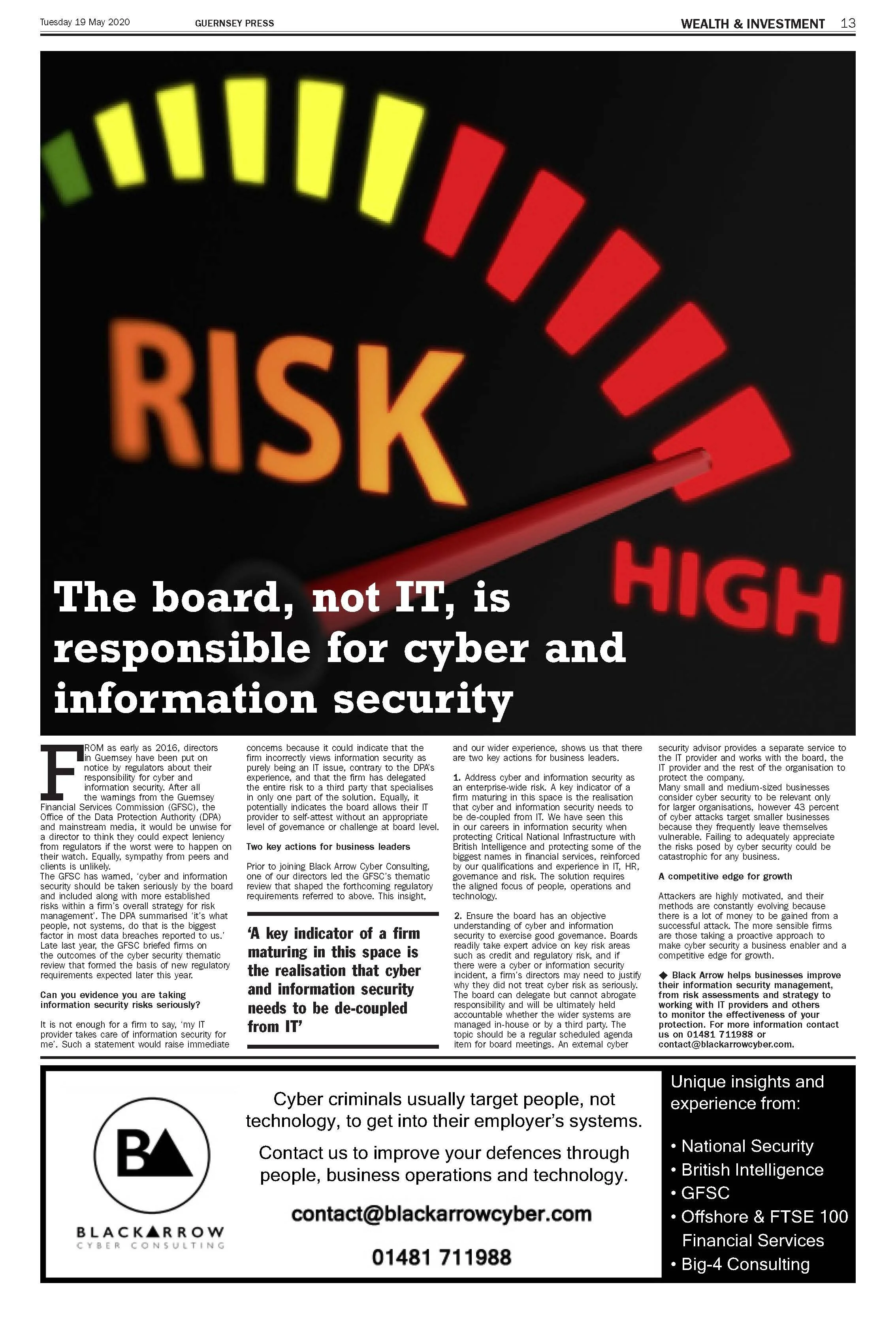
Our latest published article - Boards, not IT, are responsible for Cyber and Information Security
Our latest published article - Boards, not IT, are responsible for Cyber and Information Security
In the 19 May 2020 Guernsey Press ‘Wealth & Investments’ supplement
The online version of the supplement can be found here: https://edition.pagesuite-professional.co.uk/html5/reader/production/default.aspx?pubname=&pubid=b3a7a6a9-d5c4-49ea-94d5-aefb3f6072a9
Diffusion of Responsibility when it comes to Information Security, and why it's a bad thing for businesses - Cyber Tip Tuesday video
Welcome to this week's cyber tip Tuesday. This week we're talking about diffusion of responsibility and the problems it can cause. Security is often a casualty of diffusion of responsibility. This is characterised as the decreased responsibility of action and consequence that individuals feel, when they are part of a group. As information security is, by definition, the responsibility of everybody within an organisation, the conditions offer a perfect environment for this well-documented psychological phenomenon to emerge. You can mitigate this by introducing tighter technical controls to support your existing policies but a more effective approach is to work with your people to re-introduce individual responsibility for security. This can be through frequent training and awareness programs or by incentivising positive behaviours. If you'd like to know more about how your organisation can protect itself better, please get in touch.
Welcome to this week's cyber tip Tuesday. This week James is talking about diffusion of responsibility and the problems it can cause.
Security is often a casualty of diffusion of responsibility.
This is characterised as the decreased responsibility of action and consequence that individuals feel, when they are part of a group.
As information security is, by definition, the responsibility of everybody within an organisation, the conditions offer a perfect environment for this well-documented psychological phenomenon to emerge.
You can mitigate this by introducing tighter technical controls to support your existing policies but a more effective approach is to work with your people to re-introduce individual responsibility for security.
This can be through frequent training and awareness programs or by incentivising positive behaviours.
If you'd like to know more about how your organisation can protect itself better, please get in touch.
Cyber Weekly Flash Briefing 15 May 2020: Attacks on UK up 30% in Q1, 238% surge against banks, Microsoft fixes 111 vulns, Adobe patches 36 vulns, Thunderspy, 73m user records for sale on dark web
Cyber Weekly Flash Briefing 15 May 2020: Attacks on UK up 30% in Q1, 238% surge against banks, Microsoft fixes 111 vulns, Adobe patches 36 vulns, Thunderspy, 73m user records for sale on dark web
Links to articles are for interest and awareness and linking to or reposting external content does not endorse any service or product, likewise we are not responsible for the security of external links.
Cyber-Attacks on UK Organisations Up 30% in Q1 2020
New research has revealed that the volume of cyber-attacks on UK businesses increased by almost a third in the first three months of 2020.
Analysts identified 394,000 unique IP addresses used to attack UK businesses in the first quarter of 2020, discovering that companies with internet connections experienced 157,000 attacks each, on average – the equivalent of more than one a minute.
This rate of attack was 30% higher than the same period in 2019 when UK businesses received 120,000 internet-borne attempts to breach their systems each.
IoT applications were cited as the most common targets for cyber-criminals in the first quarter, attracting almost 19,000 online attacks per company. Company databases and file-sharing systems were also targeted frequently, with companies experiencing approximately 5000 attacks for each application, on average.
Read more here: https://www.infosecurity-magazine.com/news/cyberattacks-uk-orgs-up-30-q1/
COVID-19 blamed for 238% surge in cyber attacks against banks
The coronavirus pandemic has been connected to a 238% surge in cyber attacks against banks, new research claims.
On Thursday, VMware Carbon Black released the third edition of the Modern Bank Heists report, which says that financial organizations experienced a massive uptick in cyber attack attempts between February and April this year -- the same months in which COVID-19 began to spread rapidly across the globe.
The cyber security firm's research, which includes input from 25 CIOS at major financial institutions, adds that 80% of firms surveyed have experienced more cyber attacks over the past 12 months, an increase of 13% year-over-year.
VMware Carbon Black data already indicates that close to a third -- 27% -- of all cyber attacks target either banks or the healthcare sector.
An interesting point in the report is how there appears to have been an uptick in financially-motivated attacks around pinnacles in the news cycle, such as when the US confirmed its first case of COVID-19.
In total, 82% of chief information officers contributing to the report said that alongside a spike in attacks, techniques also appear to be improving -- including the use of social engineering and more advanced tactics to exploit not only the human factor but also weak links caused by processes and technologies in use by the supply chain.
Read more here: https://www.zdnet.com/article/covid-19-blamed-for-238-surge-in-cyberattacks-against-banks/
May 2020 Patch Tuesday: Microsoft fixes 111 vulnerabilities, 13 Critical
Microsoft's May 2020 Patch Tuesday fell this week, and Microsoft have released fixes for 111 vulnerabilities in Microsoft products. Of these vulnerabilities, 13 are classified as Critical, 91 as Important, 3 as Moderate, and 4 as Low.
This month there are no zero-day or unpatched vulnerabilities.
Users should install these security updates as soon as possible to protect Windows from known security risks.
Read more here: https://www.bleepingcomputer.com/news/microsoft/may-2020-patch-tuesday-microsoft-fixes-111-vulnerabilities-13-critical/
Adobe issues patches for 36 vulnerabilities in DNG, Reader, Acrobat
Adobe has released security patches to resolve 36 vulnerabilities present in DNG, Reader, and Acrobat software.
On Tuesday, the software giant issued two security advisories (1, 2) detailing the bugs, the worst of which can be exploited by attackers to trigger remote code execution attacks and information leaks.
The first set of patches relate to Adobe Acrobat and Reader for Windows and macOS, including Acrobat / Acrobat Reader versions 2015 and 2017, as well as Acrobat and Acrobat Reader DC.
In total, 12 critical security flaws have been resolved. Six of the bugs, a single heap overflow problem, two out-of-bounds write errors, two buffer overflow issues, and two use-after-free vulnerabilities can all lead to arbitrary code execution in the context of the current user.
Read more here: https://www.zdnet.com/article/adobe-issues-patches-for-36-vulnerabilities-in-dng-reader-acrobat/
Thunderbolt flaw ‘Thunderspy’ allows access to a PC’s data in minutes
Vulnerabilities discovered in the Thunderbolt connection standard could allow hackers to access the contents of a locked laptop’s hard drive within minutes, a security researcher from the Eindhoven University of Technology has announced. Reports state that the vulnerabilities affect all Thunderbolt-enabled PCs manufactured before 2019.
Although hackers need physical access to a Windows or Linux computer to exploit the flaws, they could theoretically gain access to all data in about five minutes even if the laptop is locked, password protected, and has an encrypted hard drive. The entire process can reportedly be completed with a series of off-the-shelf components costing just a few hundred dollars. Perhaps most worryingly, the researcher says the flaws cannot be patched in software, and that a hardware redesign will be needed to completely fix the issues.
Read more here: https://www.theverge.com/2020/5/11/21254290/thunderbolt-security-vulnerability-thunderspy-encryption-access-intel-laptops
A hacker group is selling more than 73 million user records on the dark web
A hacker group going by the name of ShinyHunters claims to have breached ten companies and is currently selling their respective user databases on a dark web marketplace for illegal products.
The hackers are the same group who breached last week Tokopedia, Indonesia's largest online store. Hackers initially leaked 15 million user records online, for free, but later put the company's entire database of 91 million user records on sale for $5,000.
Encouraged and emboldened by the profits from the Tokopedia sale, the same group has, over the course of the current week, listed the databases of 10 more companies.
This includes user databases allegedly stolen from organizations such as:
· Online dating app Zoosk (30 million user records)
· Printing service Chatbooks (15 million user records)
· South Korean fashion platform SocialShare (6 million user records)
· Food delivery service Home Chef (8 million user records)
· Online marketplace Minted (5 million user records)
· Online newspaper Chronicle of Higher Education (3 million user records)
· South Korean furniture magazine GGuMim (2 million user records)
· Health magazine Mindful (2 million user records)
· Indonesia online store Bhinneka (1.2 million user records)
· US newspaper StarTribune (1 million user records)
The listed databases total for 73.2 million user records, which the hacker is selling for around $18,000, with each database sold separately.
Read more here: https://www.zdnet.com/article/a-hacker-group-is-selling-more-than-73-million-user-records-on-the-dark-web/
A cybercrime store is selling access to more than 43,000 hacked servers
MagBo, a shadowy online marketplace where hackers sell and buy hacked servers, is doing better than ever and has soared in popularity to become the largest criminal marketplace of its kind since its launch in the summer of 2018.
Two years later, the MagBo portal has grown more than 14 times in size and is currently selling access to more than 43,000 hacked websites, up from the 3,000 sites listed in September 2018.
Today, MagBo has become the de-facto go-to marketplace for many cybercrime operations. Some groups register on the MagBo platform to sell hacked servers, while others are there just to buy.
Those who buy, do it either in bulk (for black-hat SEO or for malware distribution) or selectively, for intrusions at high-value target (e-commerce stores for web skimming, intranets for ransomware).
All in all, the MagBo platform cannot be ignored anymore, as it appears to be here to stay, and is placing itself at the heart of many of today's cybercrime operations.
Ransomware: Why paying the crooks can actually cost you more in the long run
Ransomware is so dangerous because in many cases the victim doesn't feel like they have any other option other than to pay up – especially if the alternative is the whole organisation being out of operation for weeks, or even months, as it attempts to rebuild the network from scratch.
But handing over a bitcoin ransom to cyber criminals can actually double the cost of recovery according to analysis by researchers at Sophos, published in the new State of Ransomware 2020 report, which has been released three years to the day from the start of the global WannaCry ransomware outbreak.
A survey of organisations affected by ransomware attacks found that the average total cost of a ransomware attack for organisations that paid the ransom is almost $1.4m, while for those who didn't give into ransom demands, the average cost is half of that, coming in at $732,000.
Often, this is because retrieving the encryption key from the attackers isn't a simple fix for the mess they created, meaning that not only does the organisation pay out a ransom, they also have additional costs around restoring the network when some portions of it are still locked down after the cyber criminals have taken their money.
According to the report, one in four organisations said they paid the ransom in order to get their files back. It's one of the key reasons why ransomware remains a successful tactic for crooks, because victims pay up – often sums of six-figures or more – and are therefore encouraging cyber criminals to continue with attacks that often can't be traced back to a culprit.
Read the full article here: https://www.zdnet.com/article/ransomware-why-paying-the-crooks-can-actually-cost-you-more-in-the-long-run/
This powerful Android malware stayed hidden for years, infecting tens of thousands of smartphones
A carefully managed hacking and espionage campaign is infecting smartphones with a potent form of Android malware, providing those behind it with total control of the device, while also remaining completely hidden from the user.
Mandrake spyware abuses legitimate Android functions to help gain access to everything on the compromised device in attacks that can gather almost any information about the user.
The attacker can browse and collect all data on the device, steal account credentials for accounts including banking applications. secretly take recordings of activity on the screen, track the GPS location of the user and more, all while continuously covering their tracks.
The full capabilities of Mandrake – which has been observed targeting users across Europe and the Americas – are detailed in a paper released by cybersecurity researchers this week. Mandrake has been active since 2016 and researchers previously detailed how the spyware operation was specifically targeting Australian users – but now it's targeting victims around the world.
Companies wrestle with growing cyber security threat: their own employees
Businesses deploy analytic tools to monitor staff as remote working increases data breach risk
As cyber criminals and hackers ramp up their attacks on businesses amid coronavirus-related disruption, companies are also facing another equally grave security threat: their own employees.
Companies are increasingly turning to Big Brother-style surveillance tools to stop staff from leaking or stealing sensitive data, as millions work away from the watchful eyes of their bosses and waves of job cuts leave some workers disgruntled.
In particular, a brisk market has sprung up for cyber security groups that wield machine learning and analytics to crunch data on employees’ activity and proactively flag worrying behaviours.
Read more here: https://www.ft.com/content/cae7905e-ced7-4562-b093-1ab58a557ff4
Cognizant: Ransomware Costs Could Reach $70m
IT services giant Cognizant has admitted that a ransomware attack it suffered back in April may end up costing the company as much as $70m.
The firm announced revenue of $4.2bn for the first quarter of 2020, an increase of 2.8% year-on-year. In this context, the $50-70m hit it expects to take in Q2 from the ransomware attack will not make a huge impact on the company.
However, the big numbers involved are illustrative of the persistent financial threat posed by ransomware, not to mention the reputational impact on customers.
The firm claimed on an earnings call that the company responded immediately to the threat, proactively taking systems offline after some internal assets were compromised. However, the resulting downtime and suspension of some customer accounts took their toll financially.
“Some clients opted to suspend our access to their networks,” they explained. “Billing was therefore impacted for a period of time, yet the cost of staffing these projects remained on our books.”
Remote workers were also affected as the attack hit the firm’s system for supporting its distributed workforce during the current pandemic.
Read more: https://www.infosecurity-magazine.com/news/cognizant-ransomware-costs-could/
Package delivery giant Pitney Bowes confirms second ransomware attack in 7 months
Package and mail delivery giant Pitney Bowes has suffered a second ransomware attack in the past seven months, ZDNet has learned.
The incident came to light earlier in the week after a ransomware gang known as Maze published a blog post claiming to have breached and encrypted the company's network.
The Maze crew provided proof of access in the form of 11 screenshots portraying directory listings from inside the company's computer network.
Pitney Bowes confirmed the incident stating they had detected a security incident related to Maze ransomware.
The company said it worked with third-party security consultants to take steps to stop the attack before any of its data was encrypted.
This is the second ransomware incident for Pitney Bowes in seven months.
In October 2019, Pitney Bowes disclosed a first ransomware attack. At the time, the company said it had some critical systems infected and encrypted by the Ryuk ransomware gang. The incident caused limited downtime to some package tracking systems.
Both the Ryuk and Maze ransomware gangs are what experts call "human-operated" ransomware strains. These types of ransomware infections take place after hackers breach a company's network, and take manual control of the malware to expand access to as many internal systems as possible before executing the actual ransomware to encrypt data and demand a ransom.
Read more here: https://www.zdnet.com/article/package-delivery-giant-pitney-bowes-confirms-second-ransomware-attack-in-7-months/
Law Firm Representing Drake, Lady Gaga, Madonna And More Hit By Cyber Attack As Hackers Claim To Have Stolen Personal Information And Contracts
A law firm representing many of the world's most famous celebrities has been hacked.
The website of Grubman Shire Meiselas & Sacks has been taken offline, and hackers claim to have stolen some 756GB of data relating to its clients.
Singers, actors and other stars have worked with the law firm, according to old versions of its website, with more than 200 very high-profile celebrities and companies said to have used its services.
They include Madonna, Lady Gaga, Elton John and Drake.
The hackers behind the attack claim to have person information on celebrities including letters, as well as official contracts.
Hackers have already released a purported screenshot of a Madonna contract in an attempt to prove they have access to personal files.
It is not known what the hackers are demanding in return for the files, or whether negotiations are ongoing.
"We can confirm that we've been victimised by a cyber-attack," the firm said in a media statement. "We have notified our clients and our staff.
"We have hired the world's experts who specialise in this area, and we are working around the clock to address these matters."
The hack used a piece of software known as REvil or Sodinokibi. Similar software took foreign exchange company Travelex offline in January, as part of a major hack.
Traditionally, such ransomware has been used to lock down computers and demand money from their owners to unlock them again, and grant access to files.
Increasingly, hackers threaten to release those files to the public if their demands are not met.
Read the original article: https://www.independent.co.uk/life-style/gadgets-and-tech/news/celebrity-hack-law-firm-cyber-attack-drake-madonna-lady-gaga-a9511976.html
Lights stay on despite cyber-attack on UK's electricity system
Britain’s energy system has fallen victim to a cyber-attack targeting the IT infrastructure used to run the electricity market.
The electricity system’s administrator, Elexon, confirmed that it was affected by a cyber-attack on Thursday afternoon but that the key systems used to govern the electricity market were not affected.
National Grid is investigating whether the attack could affect the part of its business tasked with keeping the lights on.
A spokesman for the energy system operator said electricity supplies had not been affected, and there were “robust cybersecurity measures in place” to make sure the UK continues to receive reliable electricity.
“We’re aware of a cyber intrusion on Elexon’s internal IT systems. We’re investigating the matter and any potential impact on our own IT networks,” he said.
Elexon is a vital part of the UK electricity market because it carefully monitors the electricity generated by energy companies to match this with what National Grid expects to receive, and to make sure that generators are paid the correct amount for the energy they generate.
Key InfoSec Terms and Concepts - Vulnerabilities, Threats, Risks and Countermeasures
Key InfoSec Terms and Concepts - Vulnerabilities, Threats, Risks and Countermeasures
Cyber Weekly Flash Brief 08 May 2020: Predatory Cyber Criminals & Hostile States Target Uk, Ransomware Payments Up, New Phishing Attack, Remote Accounts Attacked, Legal Docs Exposed, Samsung Vulns
Cyber Weekly Flash Briefing 08 May 2020: Predatory cyber criminals & hostile states target UK, ransomware payments up, new phishing attack, remote accounts attacked, legal docs exposed, Samsung vulns
If you’re pressed for time watch the 60 second quick fire summary of the top cyber and infosec stories from the last week:

Links to articles are for interest and awareness and linking to or reposting external content does not endorse any service or product, likewise we are not responsible for the security of external links.
Coronavirus: ‘Predatory’ cyber criminals and hostile states targeting UK citizens and institutions, Dominic Raab warns UK
Dominic Raab has warned that “predatory” cyber criminals and hostile states are seeking to exploit the coronavirus pandemic, saying that UK citizens, businesses and institutions will be targeted for weeks and months ahead.
His remarks follow a joint warning from cyber security agencies in Britain and the US, urging healthcare and medical research staff to improve their password security to prevent criminals exploiting the crisis further.
Speaking at No 10 earlier in the week, Mr Raab said that while the vast majority of people and countries had rallied together, “there will always be some who seek to exploit a crisis for their own criminal and hostile ends”.
The foreign secretary said he was aware that cyber criminals and “other malicious groups” are targeting individuals and organisations in the UK by deploying Covid-19 related scams and phishing emails.
“That includes groups that in the cyber security world are known as advanced persistent threat (APT) groups – sophisticated groups of hackers who try to breach computer systems,” he said.
“We have clear evidence now that these criminal gangs are actively targeting national and international organisations which are responding to the Covid-19 pandemic, which I have to say makes them particular dangers and venal at this time.”
Read the full article here: https://www.independent.co.uk/news/uk/politics/coronavirus-cyber-crime-hack-business-dominic-raab-a9500316.html
New phishing attack targeting Microsoft Teams users aims to steal Office 365 credentials
Microsoft Teams has seen a surge in usage owing to the increased need for collaboration services as more and more employees are working from home in the wake of the COVID-19 Coronavirus pandemic. With the increased adoption, the tool has also been receiving multiple improvements to help enhance functionality. While the communication of new features is a given, a new phishing attack that mimics notifications from the Redmond giant is being targeted at Teams users.
The specifics of the attack suggests that the goal is to steal users’ Teams/Office 365 credentials by serving messages that redirect to phishing websites. The report states that the email notifications impersonate automated notification emails from Teams that are convincing enough owing to the content and design. The sender email comes from the “sharepointonline-irs.com” domain, something that is misleading and one that is not owned by Microsoft.
Read more here: https://www.neowin.net/news/new-phishing-attack-targeting-microsoft-teams-users-aims-to-steal-office-365-credentials
Ransomware Payments Surge 33% as Attacks Target Remote Access
The average sum paid by enterprises to ransomware attackers surged by 33% quarter-on-quarter in the first three months of the year, as victim organisations struggled to mitigate remote working threats.
A security vendor analysed ransomware cases handled by its own incident response team during the period to compile its latest findings.
It revealed the average enterprise ransomware payment rose to over $111,000 in the quarter, although the median remained at around $44,000, reflecting the fact that most demands from online attackers are more modest.
Sodinokibi (27%), Ryuk (20%) and Phobos (8%) remained the top three most common variants in Q1 2020, although prevalence of Mamba ransomware, which features a boot-locker program and full disk encryption via commercial software, increased significantly.
Poorly secured RDP endpoints continued to be the number one vector for attacks, more popular than phishing emails or exploitation of software vulnerabilities.
Read the full article here: https://www.infosecurity-magazine.com/news/ransomware-payments-surge-33/
Millions of remote desktop accounts attacked every week
Since the start of the outbreak, we've seen cyber criminals target Zoom and spread coronavirus-related phishing campaigns, in a bid to take advantage of the increase in remote working.
Now, new research suggests criminals are also targeting employees reliant on Microsoft's proprietary Remote Desktop Protocol (RDP) with far greater regularity.
According to this new report, hundreds of thousands of employees use RDP as a way to remotely connect to their office computer with the same privileges they would have on site.
However, RDP is also an enticing target for criminals, who are reportedly bombarding the service with brute-force attacks in a bid to gain entry.
Prior to the coronavirus pandemic, researchers typically recorded around 100,000–150,000 attacks of this kind per day, but that number has shot up to almost a million.
Read more: https://www.itproportal.com/news/millions-of-remote-desktop-accounts-are-being-attacked-ever-week/
This phishing campaign targets executives with fake emails from their phone provider
A new spear-phishing campaign has targeted executives and others in attempt to steal login credentials and bank account details by posing as their smartphone provider.
Uncovered by researchers, the attacks come in the form of emails claiming to be from their mobile phone provider, and refer to a problem with their bill.
The security company said the spoof mail had been sent to "a few executives, including one at a leading financial firm".
The messages come with the vague subject 'View Bill – Error – Message' and are designed with branding that looks like they could come from EE. The message tells the victim that the company is working on fixing an unspecified problem and that the user should login to their account to update their details.
Users should be cautious about unexpected messages like this – especially, if like this one, they urge some sort of immediate action – but there's also some elements of the phishing email that should act as a warning that all is not right.
Read more here: https://www.zdnet.com/article/this-phishing-campaign-targets-executives-with-fake-emails-from-their-phone-provider/
This ransomware spreads across hundreds of devices in no time at all
The LockBit ransomware contains a feature that allows attackers to encrypt hundreds of devices in just a few hours once they've breached a corporate network.
LockBit is a fairly new Ransomware-as-a-Service (RaaS) that was launched in September of last year. The developers of the ransomware are in charge of maintaining its payment site and updates while affiliates sign up to distribute the malware. LockBit's developers then earn around 25-40 percent of the ransom payments received while the affiliates earn a slightly larger share at 60-75 percent.
Researchers have published a report revealing how a LockBit ransomware affiliate hacked into a corporate network and encrypted 25 servers and 255 workstations in just three hours.
The hackers began their attack by brute-forcing an administrator account through an outdated VPN service. This gave them the administrative credentials they needed in order to deploy the LockBit ransomware on the network.
Read more: https://www.techradar.com/news/this-ransomware-spreads-across-hundreds-of-devices-in-no-time-at-all
Data security flaw exposes details of thousands of legal documents
A data security flaw has left more than 10,000 legal documents containing sensitive details of commercial property owners unsecured for years in an online database, potentially affecting the clients of about 190 law firms.
The cache of documents, which included Companies House property transaction forms containing authentication details such as email addresses and passwords, had been scanned and uploaded by legal firms — including three of the “magic circle” — using a product from Advanced Computer Software, Britain’s third-largest software company.
Advanced, said in a statement: “We discovered some exposed data on one of our historic software platforms and took immediate steps to address the issue, secure the data and make contact with the small number of affected customers.”
Leaving a security hole open for an extended period of time exposing authentication and other details was serious.
Though the exposure of legal documents is of a different scale to recent incidents — including at Virgin Media and British Airways — involving much larger customer databases, the inclusion of authentication information raised concerns about the potential impact if the exposed data fell into the wrong hands.
Read more here: https://www.ft.com/content/e0d6b6b7-825f-4102-b78f-204e1be205b6
Vulnerabilities in two VPNs opened door to fake, malicious updates
Hackers can exploit critical vulnerabilities in PrivateVPN and Betternet – since fixed – to push out fake updates and plant malicious programs or steal data.
Attackers can intercept VPN communications and force the apps to download fake updates according to the researchers who discovered the flaws.
The researchers stated they were very surprised because these are VPNs – important cybersecurity tools that are meant to keep users safe – have a lot of users trusting these tools to provide them with more security and privacy, not less.
Read more here: https://www.scmagazine.com/home/security-news/vulnerabilities-in-two-vpns-opened-door-to-fake-malicious-updates/
Samsung Confirms Critical Security Issue For Millions: Every Galaxy After 2014 Affected
The monthly security updates from Samsung have started rolling out. If you own a Samsung smartphone that was sold from late 2014 onward, you'd better hope that update hits your device soon. Why so? Only the small matter of a "perfect 10" critical security vulnerability that can enable arbitrary remote code execution (RCE) if exploited. Oh yes, and that arbitrary RCE can happen without any user interaction needed, as this is a "zero-click" vulnerability. And if you think that sounds pretty serious, and it is, there's more to come: the vulnerability affects every Galaxy smartphone that Samsung has made from late 2014 onward.
A hacker group tried to hijack 900,000 WordPress sites over the last week
A hacker group has attempted to hijack nearly one million WordPress sites in the last seven days, according to a security alert issued this week.
Since April 28, this particular hacker group has engaged in a hacking campaign of massive proportions that caused a 30x uptick in the volume of attack traffic being tracked.
The group launched attacks from across more than 24,000 distinct IP addresses and attempted to break into more than 900,000 WordPress sites.
The attacks peaked on Sunday, May 3, when the group launched more than 20 million exploitation attempts against half a million domains.
Read the full article here: https://www.zdnet.com/article/a-hacker-group-tried-to-hijack-900000-wordpress-sites-over-the-last-week/
Popular adult streaming site just accidentally outed millions of users
Adult live streaming platform CAM4 has suffered a massive data breach, exposing the identity of millions of its users.
Discovered by security researchers, the breach was caused by a server configuration error that made 7TB of user data (comprising 10.88 billion records in total) easily discoverable online.
While the misconfigured ElasticSearch database did not betray users’ specific sexual preferences, it did include personally identifiable information including names, email addresses, payment details, chat logs and sexual orientation.
The popular adult platform is used primarily by amateur webcam models to stream explicit content to live audiences. To gain access to premium content or tip performers, users must first register with the site - parting ways with both personal and financial data.
Read more here: https://www.techradar.com/news/this-popular-adult-streaming-site-accidentally-outed-millions-of-users
Hacker Group Selling Databases With Millions Of User Credentials Busted In Poland And Switzerland
Polish and Swiss law enforcement authorities, supported by Europol and Eurojust, dismantled InfinityBlack, a hacking group involved in distributing stolen user credentials, creating and distributing malware and hacking tools, and fraud.
On 29 April 2020, the Polish National Police (Policja) searched six locations in five Polish regions and arrested five individuals believed to be members of the hacking group InfinityBlack. Police seized electronic equipment, external hard drives and hardware cryptocurrency wallets, all worth around €100 000. Two platforms with databases containing over 170 million entries were closed down by the police.
The hacking group created online platforms to sell user login credentials known as ‘combos’. The group was efficiently organised into three defined teams. Developers created tools to test the quality of the stolen databases, while testers analysed the suitability of authorisation data. Project managers then distributed subscriptions against cryptocurrency payments.
The hacking group’s main source of revenue came from stealing loyalty scheme login credentials and selling them on to other, less technical criminal gangs. These gangs would then exchange the loyalty points for expensive electronic devices.
Read more here: https://www.europol.europa.eu/newsroom/news/hacker-group-selling-databases-millions-of-user-credentials-busted-in-poland-and-switzerland
What exactly is phishing? And how good are you at spotting it? (and what to do if you clicked on something you shouldn't have) - Cyber Tip Tuesday video blog
What exactly is phishing? And how good are you at spotting it? (and what to do if you clicked on something you shouldn't have)
Cyber Weekly Flash Briefing 01 May 2020 – 50% of users feel vulnerable WFH, yet many have had no infosec training in last year, spear-phishing compromises execs in 150+ companies, Sophos zero-day
Cyber Weekly Flash Briefing for 01 May 2020 – Half of users feel vulnerable WFH and many have had no infosec training in last year, spear-phishing compromises execs in 150+ companies, Chrome vulns, Sophos firewall zero-day exploited
Links to articles are for interest and awareness and linking to or reposting external content does not endorse any service or product, likewise we are not responsible for the security of external links.
If you’re pressed for time watch the 60 second video version:
Half of remote workers feel vulnerable to growing cyber attacks
New research has revealed that almost half (49%) of employees working remotely feel vulnerable online due to the insecurity of the company laptops and PCs they are using to connect to corporate networks.
1,550 UK employees working from home during the pandemic were surveyed to better understand the security issues they've faced while working remotely.
The survey found that 42 percent of respondents received suspicious emails while 18 percent have dealt with a security breach while working from home. Of those who suffered a cyberattack, over half (51%) believed it was because they clicked on a malicious link and 18 percent believed an infected attachment was responsible.
Additionally, 42 percent of respondents reported that someone else in their household had experienced a hack of their social media accounts during the lockdown.
Read more here: https://www.techradar.com/news/half-of-remote-workers-feel-vulnerable-to-growing-cyberattacks
Many remote workers given no cyber security training
Two in three remote workers have not received any cyber security training in the past 12 months, according to a new report.
Based on a poll of 2,000 remote workers in the UK, the report states that more than three quarters (77 percent) are unconcerned about cyber security. Further, more than six in ten said they use personal devices when working from home, which poses a distinct threat to business data.
The report highlights the dangers associated with working from home and the fact cyber criminals are capitalising on the coronavirus outbreak to infect unwitting victims with malware.
With most businesses transitioning to remote working in response to lockdown measures, IT and security teams have been left with a network of unsecured, often naive workers who are easy prey for various forms of attack - especially phishing.
Read the full article here: https://www.itproportal.com/news/many-remote-workers-given-no-cybersecurity-training/
Spear-phishing campaign compromises executives at 150+ companies
A cyber crime group operating since mid-2019 has breached the email accounts of high-ranking executives at more than 150 companies, cyber-security firm Group-IB reported today.
The group, codenamed PerSwaysion, appears to have targeted the financial sector primarily, which accounted for more than half of its victims; although, victims have been recorded at companies active across other verticals as well.
PerSwaysion operations were not sophisticated, but have been extremely successful, nonetheless. Group-IB says the hackers didn't use vulnerabilities or malware in their attacks but instead relied on a classic spear-phishing technique.
They sent boobytrapped emails to executives at targeted companies in the hope of tricking high-ranking executives into entering Office 365 credentials on fake login pages.
Read the full article here: https://www.zdnet.com/article/spear-phishing-campaign-compromises-executives-at-150-companies/
Microsoft: Ransomware gangs that don't threaten to leak your data steal it anyway
Just because ransomware attackers haven't threatened to leak your company's data, it doesn't mean they haven't stolen it, Microsoft warns.
And human-operated ransomware gangs – typically associated with multi-million dollar ransom demands – haven't halted activity during the global coronavirus pandemic.
In fact, they launched more of the file-encrypting malware on target networks in the first two weeks of April than in earlier periods, causing chaos at aid organizations, medical billing companies, manufacturing, transport, government institutions, and educational software providers, according to Microsoft.
Google Confirms New Security Threat For 2 Billion Chrome Users
Google has warned of yet more security vulnerabilities in Chrome 81, which was only launched three weeks ago.
Google has confirmed two new high-rated security vulnerabilities affecting Chrome, prompting yet another update since the release of Chrome 81 on April 7. These new security threats could enable an attacker to take control of an exploited system, which is why the U.S. Cybersecurity and Infrastructure Security Agency (CISA) has advised users to apply that update now.
These popular antivirus tools share a major security flaw
More than two dozen popular antivirus solutions contain a flaw that could enable hackers to delete files, trigger crashes and install malware, according to a new report.
Popular antivirus solutions such as Microsoft Defender, McAfee Endpoint Security and Malwarebytes all feature the bug, which is described as “trivial” to abuse.
The report refers to the shared vulnerability as “symlink race” – the use of symbolic links and directory junctions to link malicious files to legitimate counterparts. This all occurs in the short space of time between an antivirus scanning and deleting a file.
"Make no mistake about it, exploiting these flaws was pretty trivial and seasoned malware authors will have no problem weaponising the tactics outlined in this blog post," said the report.
Read more: https://www.itproportal.com/news/these-popular-antivirus-tools-could-have-major-security-flaws/
Hackers are exploiting a Sophos firewall zero-day
Cyber-security firm Sophos has published an emergency security update on Saturday to patch a zero-day vulnerability in its XG enterprise firewall product that was being abused in the wild by hackers.
Sophos said it first learned of the zero-day on late Wednesday, April 22, after it received a report from one of its customers. The customer reported seeing "a suspicious field value visible in the management interface."
After investigating the report, Sophos determined this was an active attack and not an error in its product.
Read more: https://www.zdnet.com/article/hackers-are-exploiting-a-sophos-firewall-zero-day/
This sophisticated new Android trojan threatens hundreds of financial apps
Researchers have discovered a sophisticated new Android trojan that bypasses security measures and scrapes data from financial applications.
First identified in March, the EventBot banking trojan abuses Android’s accessibility features to harvest financial data and intercept SMS messages, allowing the malware to circumvent two-factor authentication.
According to the firm responsible for the discovery, EventBot targets over 200 financial applications, spanning banking, money transfer and cryptocurrency wallet services.
Affected applications include those operated by major players such as HSBC, Barclays, Revolut, Paypal and TransferWise - but many more are thought to be at risk.
Microsoft Office 365: US issues security alert over rushed remote deployments
The US Department of Homeland Security's Cybersecurity and Infrastructure Security Agency (CISA) has published security advice for organizations that may have rushed out Office 365 deployments to support remote working during the coronavirus pandemic.
CISA warns that it continues to see organizations that have failed to implement security best practices for their Office 365 implementation. It is concerned that hurried deployments may have lead to important security configuration oversights that could be exploited by attackers.
"In recent weeks, organizations have been forced to change their collaboration methods to support a full 'work from home' workforce," CISA notes in the new alert.
Financial sector is seeing more credential stuffing than DDoS attacks
The financial sector has seen more brute-force attacks and credential stuffing incidents than DDoS attacks in the past three years according to a report published this week.
Statistics about attacks carried out against banks, credit unions, brokers, insurance, and the wide range of organizations that serve them, such as payment processors and financial Software as a Service (Saas).
The report's findings dispel the notion that DDoS attacks are one of today's most prevalent threats against the financial vertical.
The report states that brute force attacks, credential stuffing, and all the other account takeover (ATO) attacks have been a much bigger threat to the financial sector between 2017 and 2019. This includes all the ATO variations such as:
· Brute-force attacks - attackers try common or weak username/passwords pairs (from a preset list) to brute-force their way into an account
· Credential stuffing - attackers try username/password pairs leaked at other sites
· Password spraying - attackers try the same password, but against different usernames
Read more here: https://www.zdnet.com/article/financial-sector-has-been-seeing-more-credential-stuffing-than-ddos-attacks-in-recent-years/
This buggy WordPress plugin allows hackers to lace websites with malicious code
Security researchers have identified a flaw in the Real-Time Find and Replace WordPress plugin that could allow hackers to lace websites with malicious code.
The affected plugin affords WordPress users the ability to edit website code and text content in real-time, without having to go into the backend - and reportedly features on over 100,000 sites.
The exploit manipulates a Cross-Site Request Forgery (CSRF) flaw in the plugin, which the hacker can use to push infected content to the website and create new admin accounts.
Read more here: https://www.techradar.com/news/this-buggy-wordpress-plugin-allows-hackers-to-lace-websites-with-malicious-code
Zoom Gets Stuffed: Here’s How Hackers Got Hold Of 500,000 Passwords
At the start of April, the news broke that 500,000 stolen Zoom passwords were up for sale. Here's how the hackers got hold of them.
More than half a million Zoom account credentials, usernames and passwords were made available in dark web crime forums earlier this month. Some were given away for free while others were sold for as low as a penny each.
Researchers at a threat intelligence provider obtained multiple databases containing Zoom credentials and got to work analysing exactly how the hackers got hold of them in the first place.
Read more here: https://www.forbes.com/sites/daveywinder/2020/04/28/zoom-gets-stuffed-heres-how-hackers-got-hold-of-500000-passwords/#6586d7be5cdc
Sophisticated Android Spyware Attack Spreads via Google Play
The PhantomLance espionage campaign is targeting specific victims, mainly in Southeast Asia — and could be the work of the OceanLotus APT.
A sophisticated, ongoing espionage campaign aimed at Android users in Asia is likely the work of the OceanLotus advanced persistent threat (APT) actor, researchers said this week.
Dubbed PhantomLance by Kaspersky, the campaign is centered around a complex spyware that’s distributed via dozens of apps within the Google Play official market, as well as other outlets like the third-party marketplace known as APKpure.
The effort, though first spotted last year, stretches back to at least 2016, according to findings released at the SAS@home virtual security conference on Tuesday.
Read more here: https://threatpost.com/sophisticated-android-spyware-google-play/155202/
Skype phishing attack targets remote workers
Remote workers have been warned to take extra care when using video conferencing software after a new phishing scam was uncovered.
Researchers from a security firm have revealed hackers are using emails pretending to be from Skype, the popular Microsoft-owned video calling tool, in order to trick home workers into handing over their login details.
Criminals could then use these logins to access corporate networks to spread malware or steal valuable information.
Read more here: https://www.techradar.com/news/skype-phishing-attack-targets-remote-workers
How Much Security is Enough Security - Cyber Tip Tuesday video blog for 28 March 2020
How much security is enough security?
You can never have too much security - right…?!
Maybe not - watch to find out
How much security is enough security?
You can never have too much security - right…?!
Maybe not - watch to find out
Cyber Weekly Flash Briefing for 24 April 2020 – increase in data breaches with staff WFH, MS out of band patch for Office, hackers breach ad servers, 309m Facebooks users details compromised
Cyber Weekly Flash Briefing for 24 April 2020 – increase in data breaches with staff WFH, MS out of band patch for Office, hackers breach ad servers, 309m Facebooks users compromised
Links to articles are for interest and awareness and linking to or reposting external content does not endorse any service or product, likewise we are not responsible for the security of external links.
The week in 60 seconds - video flash briefing
Over half of organisations expect remote workers to increase the risk of a data breach
Apathy towards cyber security remains one of the biggest challenges for businesses.
The majority of UK’s IT decision-makers believe remote workers will expose their businesses to the risk of a data breach.
This is according to a new report which claims the awareness of the issue has been “steadily growing” over the last three years.
While the report does not offer definitive explanations for the rise, it cites increased remote working due to the coronavirus as a contributing factor.
The percentage of employees intentionally putting data at risk dropped slightly (from 47 to 44 percent), but apathy continues to be a “major problem”.
However, remote working appears to have forced IT decision-makers to pay closer attention to security.
Almost all (96 percent) respondents acknowledged risks associated with BYOD policies and a significant portion of those (42 percent) only allow the use of pre-approved gear (up from 11 percent last year).
This change is “crucial”, as lost and misplaced devices are now the second biggest data breach cause (24 percent), behind intentionally putting data at risk (33 percent) and ahead of mishandling corporate data.
Trickbot Named Most Prolific #COVID19 Malware
Notorious malware Trickbot has been linked to more COVID-19 phishing emails than any other, according to new data from Microsoft.
The Microsoft Security Intelligence Twitter account made the claim on Friday.
“Based on Office 365 ATP data, Trickbot is the most prolific malware operation using COVID-19 themed lures,” it said. “This week’s campaign uses several hundreds of unique macro-laced document attachments in emails that pose as messages from a non-profit offering a free COVID-19 test.”
Microsoft has been providing regular updates through the current crisis as organizations struggle to securely manage an explosion in home working while cyber-criminals step up efforts to exploit stretched IT security teams and distracted employees.
Read more: https://www.infosecurity-magazine.com/news/trickbot-named-most-prolific/
Microsoft Issues Out-Of-Band Security Update For Office, Paint 3D
Microsoft has released an out-of-band security update for Microsoft Office, Office 365 ProPlus and Paint 3D. The applications are affected by multiple Autodesk vulnerabilities that, if exploited, could enable remote code execution.
The flaws, all rated “important” in severity, are tied to six CVEs stemming from Autodesk’s library for FBX, a popular file format format that supports 3D models. This library is integrated into certain Microsoft applications
Read more: https://threatpost.com/microsoft-issues-out-of-band-security-update-for-office-paint-3d/155016/
1,000 may be hit by CISI website fraud attack
The CISI has launched an investigation after a website attack resulted in 1,000 customers and members being exposed to the risk of credit card fraud.
The professional body with 45,000 members says some members have reported “fraudulent activity” on their cards following a payment transaction on the CISI website.
The organisation, which provides the Certified Financial Planner and Chartered Wealth manager designations, has launched a probe with help from its insurers and KPMG.
The CISI has contacted 5,785 customers that processed a payment transaction through its website between 1 February 2020 and 15 April 2020.
It said not all of these have seen “fraudulent activity” but it anticipates about 1,000 have been exposed to a risk of fraud.
Here's a list of all the ransomware gangs who will steal and leak your data if you don't pay
Starting with late 2019 and early 2020, the operators of several ransomware strains have begun adopting a new tactic.
In an attempt to put additional pressure on hacked companies to pay ransom demands, several ransomware groups have also begun stealing data from their networks before encrypting it.
If the victim -- usually a large company -- refuses to pay, the ransomware gangs threaten to leak the information online, on so-called "leak sites" and then tip journalists about the company's security incident.
Companies who may try to keep the incident under wraps, or who may not want intellectual property leaked online, where competitors could get, will usually cave in and pay the ransom demand.
While initially the tactic was pioneered by the Maze ransomware gang in December 2019, it is now becoming a widespread practice among other groups as well.
Clop, Doppenpaymer, Maze, Nefilim, Nemty, Ragnarlocker, Revil (Sodinokibi), Sekhmet, Snatch
Read the original article here for full details: https://www.zdnet.com/article/heres-a-list-of-all-the-ransomware-gangs-who-will-steal-and-leak-your-data-if-you-dont-pay/
Hackers have breached 60 ad servers to load their own malicious ads
A mysterious hacker group has been taking over ad servers for the past nine months in order to insert malicious ads into their ad inventory, ads that redirect users to malware download sites.
This clever hacking campaign was discovered last month and appears to have been running for at least nine months, since August 2019.
Hackers have targeted advertising networks running old versions of the Revive open-source ad server. Hackers breach outdated Revive servers and silently append malicious code to existing ads.
Once the tainted ads load on legitimate sites, the malicious code hijacks and redirects site visitors to websites offering malware-laced files -- usually disguised as Adobe Flash Player updates.
Read more: https://www.zdnet.com/article/hackers-have-breached-60-ad-servers-to-load-their-own-malicious-ads/
GCHQ calls on public to report coronavirus-related phishing emails
GCHQ is asking members of the public to report suspicious emails they have received amid a wave of scams and hacking attacks that seek to exploit fear of Covid-19 to enrich cybercriminals.
The National Cyber Security Centre, a branch of the intelligence agency, has launched the suspicious email reporting service with a simple request of the public: forward any dubious emails to report@phishing.gov.uk, and the NCSC’s automated scanning system will check for scam emails and immediately remove criminal sites.
Read more here: https://www.theguardian.com/technology/2020/apr/21/gchq-calls-public-report-coronavirus-phishing-emails
Hackers exploit bug to access iPhone users’ emails
Hackers have devised a way to install malicious software on iPhones without getting the victim to download an attachment or click on any links.
Cybersecurity researchers have discovered a bug in the phone’s email app that hackers may have been exploiting since January 2018. It enables hackers to access all emails on a phone, as well as remotely modify or delete them.
Typically, an attack on a phone requires a user to download the malware, such as clicking on a link in a message or on an attachment. Yet in this case, hackers send a blank email to the user. When the email is opened, a bug is triggered that causes the Mail app to crash, forcing the user to reboot it. During the reboot, hackers could access information on the device.
The hack is virtually undetectable by victims due to the sophisticated nature of the attack and Apple’s own security measures, which often make investigating the devices for potential vulnerabilities a challenge, experts claim.
More here: https://www.thetimes.co.uk/article/hackers-exploit-bug-to-access-iphone-users-emails-ssvvztrgf
FBI Sees Cybercrime Reports Increase Fourfold During COVID-19 Outbreak
Instances of cybercrime appear to have jumped by as much as 300 percent since the beginning of the coronavirus pandemic, according to the FBI. The bureau’s Internet Crime Complain Center (IC3) said last week that it’s now receiving between 3,000 and 4,000 cybersecurity complaints every day, up from the average 1,000 complaints per day the center saw before COVID-19 took hold.
While much of this jump can be attributed to America’s daily activities increasingly moving online — newly remote workers unaware of basic security measures or companies struggling to keep externally-accessed systems secure, for example — the FBI says a lot of the increased cybercrime is coming from nation states seeking out COVID-19-related research.
309 million Facebook users’ phone numbers found online
Last weekend, researchers came across a database with 267m Facebook user profiles being sold on the Dark Web.
Looking to verify the records and add them to the firm’s breach notification service, the researchers bought it, for the grand total of £500.
That works out to USD $540 — or about 0.0002 cents — per record. The records held Facebook users’ IDs, which are unique, public numbers associated with specific accounts that can be used to figure out an account’s username and other profile info. The records also included full names, email addresses, phone numbers, timestamps for last connection, relationship status and age.
Fortunately, there were no passwords exposed, but the breach still forms a perfect tool kit for an email or text phishing campaign that looks like it’s coming from Facebook itself. If enough users get fooled into clicking on spearphishers’ rigged links, it could lead to the exposure of even more, and more valuable, data.
Read more here: https://nakedsecurity.sophos.com/2020/04/22/309-million-facebook-users-phone-numbers-and-more-found-online/
Google Issues Warning For 2 Billion Chrome Users
Google just gave its two billion Chrome users a brilliant (if long overdue) upgrade, but it doesn’t mask all of the controversial changes, security problems and data concerns which have worried users about the browser recently. And now Google has issued a new critical warning you need to know about.
Chrome has a critical security flaw across Windows, Mac and Linux and it urges users to upgrade to the latest version of the browser (81.0.4044.113). Interestingly, at the time of publication, Google is also keeping the exact details of the exploit a mystery.
Zoom announces 5.0 update with tougher encryption and new security features
Zoom has today announced its new 5.0 update, bringing robust new security features including AES 256-bit GCM encryption.
Zoom says that AES 256-bit GCM encryption will "raise the bar for securing our users' data in transit", providing "confidentiality and integrity assurances on your Zoom Meeting, Zoom Video Webinar and Zoom Phone Data." The systemwide enablement of this new security standard will take place on May 30.
Zoom has also introduced a new security icon, where it has grouped its security features in one place within Zoom's meeting menu bar. It has also introduced more robust host controls, including a 'report a user' feature. Waiting rooms now default to on, as do meeting passwords and cloud recording passwords. Zoom has also introduced a new data structure for linking contacts within larger organizations. Previously, a Zoom feature designed to group users by domain name had seen thousands of random users grouped together, sharing lots of information with strangers.
Read more: https://www.androidcentral.com/zoom-announces-50-update-tougher-encryption-and-new-security-features
Temporary coronavirus hospitals face growing cybersecurity risks
The coronavirus outbreak has led to a series of temporary medical facilities opening across the U.S., most of which will use remote-care devices without the proper protection against hackers. Because of their remoteness and the overall uncertainty that pandemic’s created, cybersecurity at these temporary hospitals has fallen to the wayside and risks are at an all-time high.
Further complicating matters, most of these temporary units are highly dependent on connected medical devices to facilitate remote care. This leaves these hospitals open to hackers stealing patients’ personal health information via these connected devices.
Fortunately, there are a number of steps health care organizations can take to protect their remote facilities. Not only should organizations ensure their software is up to date and fully patched, but they should also consider enabling two-factor authentication for every account that’s granted access to the remote center’s system.
To assist with securing these remote health care locations, Microsoft has expanded the availability of its AccountGuard security service program. Currently offered at no cost to health care providers on the front lines of the coronavirus outbreak, Microsoft’s AccountGuard service helps targeted organizations protect themselves from ongoing cybersecurity threats.
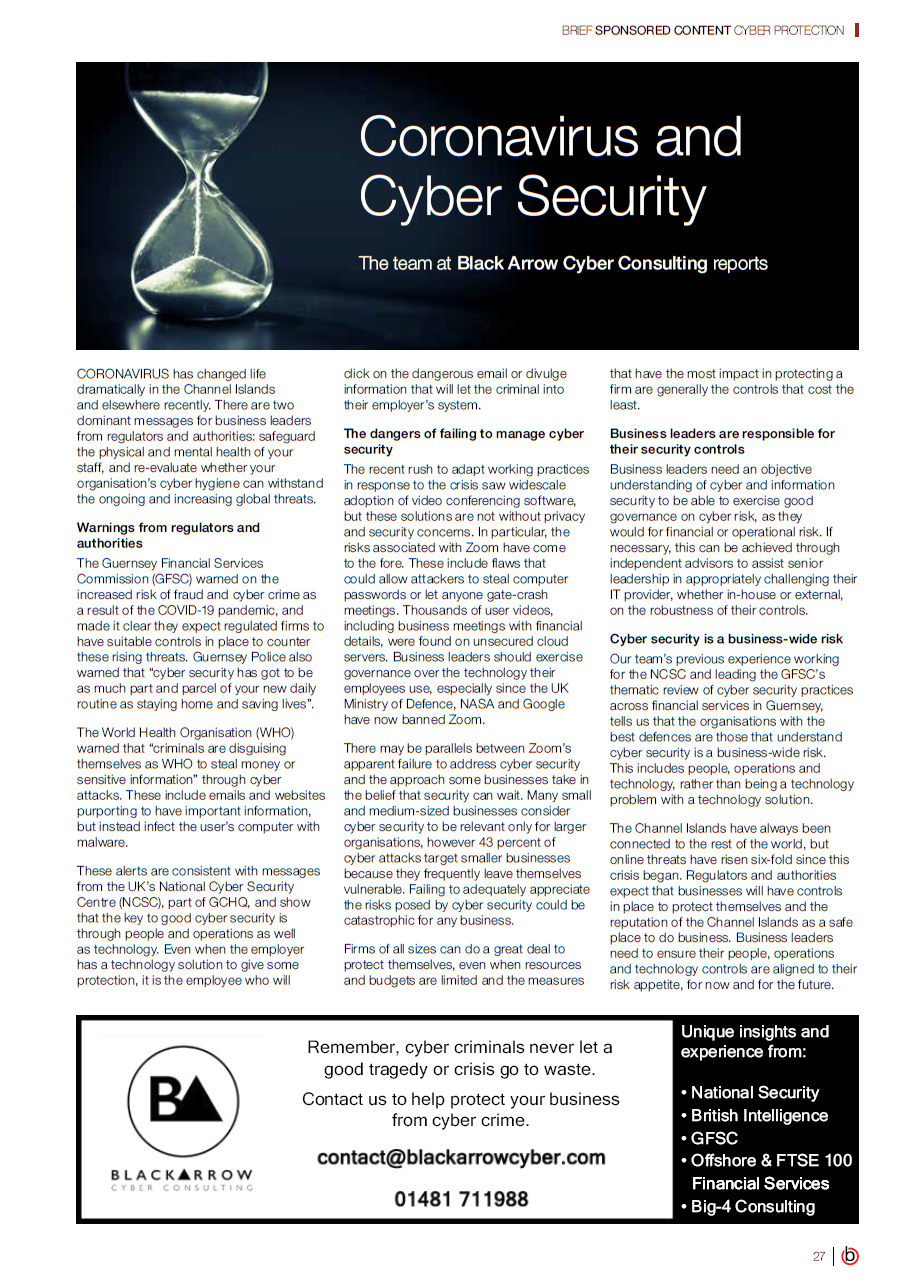
For this week's Cyber Tip Tuesday video Bruce explains the basics of ransomware
Welcome to this week's Tip Tuesday, this week Bruce talks about the basics of Ransomware. Ransomware is malicious software, or malware, that criminals install on your computer to encrypt your data and lock down your computers. The criminal then demands payment in exchange for giving you back your information.
Welcome to this week's Tip Tuesday, this week Bruce talks about the basics of Ransomware.
Ransomware is malicious software, or malware, that criminals install on your computer to encrypt your data and lock down your computers. The criminal then demands payment in exchange for giving you back your information.
This usually starts with your employee clicking on a link in an email or an attachment. The malware then spreads across your network and corrupts your computers. In some cases, it will also take a copy of your data and send it to the criminal.
One of the classic ways to reduce the risk of successful ransomware is to take a regular back up of your information, so that you can revert to that copy and continue with your business. But now criminals are threatening to publish your confidential information online if you don't pay, which can severally damage your reputation and potentially destroy your business.
So the best thing is to avoid being a victim by implementing a range of controls, including stopping the criminal entering your system.
Cyber Weekly Flash Briefing for 17 April 2020 – More Top Companies Ban Zoom, Microsoft fixes 3 zero-days, 2 being actively exploited, 500,000 Zoom accounts sold online, Sinister new Botnet
Cyber Weekly Flash Briefing for 17 April 2020 – More Top Companies Ban Zoom, Microsoft fixes 3 zero-days, 2 being actively exploited, 500,000 Zoom accounts sold online, Sinister new Botnet
Links to articles are for interest and awareness and linking to or reposting external content does not endorse any service or product, likewise we are not responsible for the security of external links.
60 second video version of this week’s flash briefing
More top companies ban Zoom following security fears
As usage of Zoom rises amidst the global pandemic, more companies are telling their staff to stay off the video conferencing service due to security concerns.
Among the latest organisations to block the use of Zoom are German industrial giant Siemens, which sent out an internal circular urging its employees to not use the tool for video conferencing, with Standard Chartered Bank also issuing a similar note to its staff.
The latter has told employees to avoid Google Hangouts, which has also emerged as another popular teleconferencing application in recent weeks.
Read more here: https://www.techradar.com/uk/news/more-top-companies-ban-zoom-following-security-fears
Over 500,000 Zoom accounts sold on hacker forums, the dark web
Over 500,000 Zoom accounts are being sold on the dark web and hacker forums for less than a penny each, and in some cases, given away for free.
These credentials are gathered through credential stuffing attacks where threat actors attempt to login to Zoom using accounts leaked in older data breaches. The successful logins are then compiled into lists that are sold to other hackers.
Some of these Zoom accounts are offered for free on hacker forums so that hackers can use them in zoom-bombing pranks and malicious activities. Others are sold for less than a penny each.
Read more here: https://www.bleepingcomputer.com/news/security/over-500-000-zoom-accounts-sold-on-hacker-forums-the-dark-web/
Microsoft April 2020 Patch Tuesday fixes 3 zero-days – 2 of which being actively exploited, 15 critical flaws
Microsoft's April 2020 Patch Tuesday fell this week, and with everything going on, it is going to be particularly stressful for Windows administrators.
With the release of the April 2020 security updates, Microsoft has released fixes for 113 vulnerabilities in Microsoft products. Of these vulnerabilities, 15 are classified as Critical, 93 as Important, 3 as Moderate, and 2 as Low.
Of particular interest, Microsoft patched three zero-day vulnerabilities, with two of them being seen actively exploited in attacks.
Users should install these security updates as soon as possible to protect Windows from known security risks.
Read more here: https://www.bleepingcomputer.com/news/microsoft/microsoft-april-2020-patch-tuesday-fixes-3-zero-days-15-critical-flaws/
Hackers Are Selling a Critical Zoom Zero-Day Exploit for £400,000
Hackers are selling two critical vulnerabilities for the video conferencing software Zoom, one for Windows and one for MacOS that would allow someone to hack users and spy on their calls.
The two flaws are so-called zero-days, and are currently present in Zoom’s Windows and MacOS clients, according to three sources who are knowledgeable about the market for these kinds of hacks. The sources have not seen the actual code for these vulnerabilities, but have been contacted by brokers offering them for sale.
Zero-day exploits or just zero-days or 0days are unknown vulnerabilities in software or hardware that hackers can take advantage of to hack targets. Depending on what software they’re in, they can be sold for thousands or even millions of dollars.
Phishing kit prices skyrocketed in 2019 by 149%
The average price of a phishing kit sold on cybercrime markets has gone up in 2019 by 149% according to new findings released this week based on analysis of ads posted on known cybercrime markets and hacking forums.
The average price for phishing kits sold on the cybercrime underground in 2019 has skyrocketed to $304 on average last year, up from only $122 recorded in 2018.
Phishing kit prices rose despite an increase in the number of kit sellers (up by 120%) and the number of phishing kit ads (doubled in 2019).
Of the 16,200 phishing kits identified and tracked in 2019, the most targeted login pages were for Amazon, Google, Instagram, Office 365, and PayPal.
Amazon and PayPal are known targets of phishing operations, as access to both accounts can allow hackers to make fraudulent transactions with victims' funds.
More here: https://www.zdnet.com/article/phishing-kit-prices-skyrocketed-in-2019-by-149/
A Sinister New Botnet Could Prove Nearly Impossible To Stop
Security researchers have discovered an emerging threat that they fear could be nearly unstoppable. This growing botnet has already managed to enslave nearly 20,000 computers.
It is known as DDG, and it’s been lurking in the shadows for at least two years. DDG was first discovered in early 2018.
Back then the nascent botnet had control of just over 4,000 so-called zombies and used them to mine the Monero cryptocurrency. Much has changed since then.
Today’s incarnation of DDG isn’t just five times larger. It’s also much more sophisticated.
One of its distinguishing features is its command and control system. Most botnets are designed around a client/server model. Infected machines listen for instructions from the servers and then carry out their orders.
MSC Data Centre Closes Following Suspected Cyber-Attack
A container shipping company has said malware could be to blame for the closure of one of its data centres last week.
The Mediterranean Shipping Company (MSC) took to Twitter on Good Friday to report a network outage issue affecting the website msc.com, which was still down at time of writing.
The incident, which is thought to have occurred on Thursday, April 9, also brought down the shipping company's myMSC portal.
A message posted from the Twitter account MSC Cargo on April 10 stated: "We are sorry to inform you that http://MSC.com and myMSC are currently not available as we've experienced a network outage in one of our data centers. We are working on fixing the issue."
As a result of the outage, self-service tools for making and managing bookings on MSC ships have ceased to be operational. Alternative booking platforms are available, and customers can still book via email and over the phone.
Read the original article here: https://www.infosecurity-magazine.com/news/msc-suffers-suspected-cyberattack/
Core Concepts of Information Security - introducing the Functionality, Usability and Security triangle - video explainer series
Core Concepts of Information Security - introducing the Functionality, Usability and Security triangle - video explainer series
Cyber Weekly Flash Briefing for 11 April 2020 – NCSC advisory on COVID activity, Travelex pays $2.3M ransom, Zoom tries to get better, Shadow IT risks, Unkillable Android malware, Bot traffic up
Cyber Weekly Flash Briefing for 11 April 2020 – NCSC advisory on COVID activity, Travelex pays $2.3M ransom, Zoom tries to get better, Shadow IT risks, Unkillable Android malware, Bot traffic up
Links to articles are for interest and awareness and linking to or reposting external content does not endorse any service or product, likewise we are not responsible for the security of external links.
60 second video flash briefing
UK NCSC and US CISA issue joint Advisory: COVID-19 exploited by malicious cyber actors
A joint advisory was put out from the United Kingdom’s National Cyber Security Centre (NCSC) and the United States Department of Homeland Security (DHS) Cybersecurity and Infrastructure Security Agency (CISA) relating to information on exploitation by cyber criminal and advanced persistent threat (APT) groups of the current coronavirus disease 2019 (COVID-19) global pandemic. It includes a non-exhaustive list of indicators of compromise (IOCs) for detection as well as mitigation advice.
Read more here: https://www.ncsc.gov.uk/news/covid-19-exploited-by-cyber-actors-advisory
Download the advisory notice here: https://www.ncsc.gov.uk/files/Final%20Joint%20Advisory%20COVID-19%20exploited%20by%20malicious%20cyber%20actors%20v3.pdf
Travelex paid $2.3M in Bitcoin to get its systems back from hackers
Travelex paid hackers $2.3 million worth of Bitcoin to regain access to its computer systems after a devastating ransomware attack on New Year’s Eve.
The London-based company said it decided to pay the 285 BTC based on the advice of experts, and had kept regulators and partners in the loop throughout the recovery process.
Although Travelex, which manages the world’s largest chain of money exchange shops and kiosks, did confirm the ransomware attack when it happened, it hadn’t yet disclosed a Bitcoin ransom had been paid to restore its systems.
Travelex previously blamed the attack on malware known as Sodinokibi, a ‘Ransomware-as-a-Service’ tool-kit that has recently begun publishing data stolen from companies that don’t pay up.
Travelex‘ operations were crippled for almost all of January, with its public-facing websites, app, and internal networks completely offline. It also reportedly interrupted cash deliveries to major banks in the UK, including Barclays and Lloyds.
At the time, BBC claimed that Travelex‘ attackers had demanded $6 million worth of Bitcoin to unlock its systems.
Zoom sets up CISO Council and hires ex-CSO of Facebook to clean up its privacy mess
The ongoing coronavirus pandemic has seen people relying on work collaboration apps like Teams and Slack to talk to others or conduct meetings. Zoom, in particular, has seen incredible growth over the past few weeks but it came at a cost. The company has been under a microscope after various researchers discovered a number of security flaws in the app. To Zoom’s credit, the company responded immediately and paused feature updates to focus on security issues.
The company announced that it’s taking help from CISOs to improve the security and patch the flaws in the app. Zoom will be taking help from CISOs from HSBC, NTT Data, Procore, and Ellie Mae, among others. Moreover, the company is also setting up an Advisory Board that will include security leaders from VMware, Netflix, Uber, Electronic Arts, and others. Lastly, the company has also asked Alex Stamos, ex-CSO of Facebook to join as an outside advisor. Alex is a well-known personality in the cybersecurity world who left Facebook after an alleged conflict of interest with other executives about how to address the Russian government’s use of its platform to spread disinformation during the 2016 U.S. presidential election.
Read more here: https://mspoweruser.com/zoom-ciso-hires-ex-facebook-cso-clean-its-mess/
Researchers discover IoT botnet capable of launching various DDoS attacks
Cyber security researchers have found a new botnet comprised of more than a thousand IoT devices, capable of launching distributed denial of service (DDoS) attacks.
According to a report, researchers have named the botnet Dark Nexus, and believe it was created by well-known malware developer greek.Helios - a group that has been selling DDoS services and botnet code for at least the past three years.
Analysing the botnet through a honeypot, the researchers found it is comprised of 1,372 bots, but believe it could grow extremely quickly.
Dark Nexus is based on Mirai and Qbot, but has seen some 40 iterations since December 2020, with improvements and new features added almost daily.
Read the original article here: https://www.itproportal.com/news/researchers-discover-iot-botnet-capable-of-launching-various-ddos-attacks/
Microsoft: Cyber-Criminals Are Targeting Businesses Through Vulnerable Employees
Microsoft has warned that cyber-criminals are preying on people’s vulnerable psychological states during the COVID-19 pandemic to attack businesses. During a virtual press briefing, the multinational technology company provided data showing how home working and employee stress during this period has precipitated a huge amount of COVID-19-related attacks, particularly phishing scams.
Working from home at this time is very distracting for a lot of people, particularly if they are looking after children. Additionally, many individuals are in a stressful state with the extra pressures and worries as a result of COVID-19. This environment is providing new opportunities for cyber-criminals to operate.
“We’re seeing a significant increase in COVID-related phishing lures for our customers,” confirmed Microsoft. “We’re blocking roughly 24,000 bad emails a day with COVID-19 lures and we’ve also been able to see and block through our smart screen 18,000 malicious COVID-themed URLs and IP addresses on a single day, so the volume of attacks is quite high.”
Read the original article here: https://www.infosecurity-magazine.com/news/cybercriminals-targeting/
Stolen Zoom account credentials are freely available on the dark web
Loved, hated, trusted and feared in just about equal measure, Zoom has been all but unavoidable in recent weeks. Following on from a combination of privacy and security scandals, credentials for numerous Zoom account have been found on the dark web.
The credentials were hardly hidden -- aside from being on the dark web. Details were shared on a popular forum, including the email address, password, meeting ID, host key and host name associated with compromised accounts.
Read more: https://betanews.com/2020/04/08/zoom-account-credentials-dark-web/
Shadow IT Represents Major #COVID19 Home Working Threat
Rising threat levels and remote working challenges stemming from the COVID-19 pandemic are putting increased pressure on IT security professionals, according to new data.
A poll of over 400 respondents from global organisations with over 500 employees was conducted to better understand the current challenges facing security teams.
It revealed that 71% of security professionals had reported an increase in security threats or attacks since the start of the virus outbreak. Phishing (55%), malicious websites (32%), malware (28%) and ransomware (19%) were cited as the top threats.
These have been exacerbated by home working challenges, with 95% of respondents claiming to be under new pressures.
Top among these was providing secure remote access for employees (56%) and scalable remote access solutions (55%). However, nearly half (47%) of respondents complained that home workers using shadow IT solutions represented a major problem.
These challenges are only going to grow, according to the research.
Read more here: https://www.infosecurity-magazine.com/news/shadow-it-covid19-home-working/
'Unkillable' Android malware gives hackers full remote access to your phone
Security experts are warning Android users about a particularly nasty strain of malware that's almost impossible to remove.
A researcher has written a blog post explaining how the xHelper malware uses a system of nested programs, not unlike a Russian matryoshka doll, that makes it incredibly stubborn.
The xHelper malware was first discovered last year, but the researcher has only now established exactly how it gets its claws so deeply into your device, and reappears even after a system restore.
Although the Google Play Store isn't foolproof, unofficial third party app stores are much more likely to harbour malicious apps. App-screening service Google Play Protect blocked more than 1.9 million malware-laced app installs last year, including many side-loaded or installed from unofficial sources, but it's not foolproof.
xHelper is often distributed through third-party stores disguised as a popular cleanup or maintenance app to boost your phone's performance, and once there, is amazingly stubborn.
Decade of the RATs (Remote Access Trojan): Novel APT Attacks Targeting Linux, Windows and Android
BlackBerry researchers have released a new report that examines how five related APT groups operating in the interest of the Chinese government have systematically targeted Linux servers, Windows systems and Android mobile devices while remaining undetected for nearly a decade.
The report comes on the heels of the U.S. Department of Justice announcing several high-profile indictments from over 1,000 open FBI investigations into economic espionage as part of the DOJ’s China Initiative.
The BlackBerry report, titled Decade of the RATs: Cross-Platform APT Espionage Attacks Targeting Linux, Windows and Android, examines how APTs have leveraged the “always on, always available” nature of Linux servers to establish a “beachhead” for operations. Given the profile of the five APT groups involved and the duration of the attacks, it is likely the number of impacted organisations is significant.
The cross-platform aspect of the attacks is also of particular concern in light of security challenges posed by the sudden increase in remote workers. The tools identified in these ongoing attack campaigns are already in place to take advantage of work-from-home mandates, and the diminished number of personnel onsite to maintain security of these critical systems compounds the risks. While the majority of the workforce has left the office as part of containment efforts in response to the Covid-19 outbreak, intellectual property remains in enterprise data centres, most of which run on Linux.
Most large organizations rely on Linux to run websites, proxy network traffic and store valuable data. While Linux may not have the visibility that other front-office operating systems have, it is arguably the most critical where the security of critical networks is concerned. Linux runs nearly all of the top 1 million websites, 75% of all web servers, 98% of the world’s supercomputers and 75% of major cloud service providers (Netcraft, 2019, Linux Foundation, 2020).
More here: https://blogs.blackberry.com/en/2020/04/decade-of-the-rats
Bot traffic fueling rise of fake news and cybercrime
The coronavirus pandemic has disrupted daily life around the world and the WHO recently warned that an overabundance of information about the virus makes it difficult for people to differentiate between legitimate news and misleading information.
At the same time, EU security services have warned that Russia is aggressively exploiting the coronavirus pandemic to push disinformation and weaken Western society through its bot army.
A cyber security firm has been using its bot manager to monitor internet traffic in an attempt to track the “infodemic” that both the WHO and EU security services have issued warnings on.
According to the data, bots have upped their game and organisations in the social media, ecommerce and digital publishing industries have experienced a surge in bad bot traffic following the coronavirus outbreak.
The bots have been found to be executing various insidious activities including spreading disinformation, spam commenting and more. In February, 58.1 percent of bots had the capability to mimic human behaviour. This means that they can disguise their identities, create fake accounts on social media sites and post their masters' propaganda while appearing as a genuine user.
Read more here: https://www.techradar.com/news/bot-traffic-fueling-rise-of-fake-news-and-cybercrime
Our Top Tips for Small Businesses During the Coronavirus Crisis
In collaboration with the new Guernsey Startup Hub these are our top tips for small businesses to help keep them secure online at this difficult time
In collaboration with the new Guernsey Startup Hub these are our top tips for small businesses to help keep them secure online at this difficult time
Cyber Weekly Flash Briefing 03 April 2020 – GFSC warn over increased fraud & cybercrime, attacks up 37% in a month, criminals sending USB devices in post, Zoom phishers register 2000 domains
Cyber Weekly Flash Briefing for 03 April 2020 – GFSC warns over increased risk of fraud and cyber crime, Attacks Up 37% over last month, criminals sending USB device in post, Zoom Phishers Register 2000 Domains in a Month, increase in DDoS attacks
Links to articles are for interest and awareness and linking to or reposting external content does not endorse any service or product, likewise we are not responsible for the security of external links.
GFSC warns over increased risk of fraud and cyber crime
The GFSC has put out a warning to regulated firms on the Island around increased likelihood of fraud and other cyber crimes as a result of the COVID-19 pandemic.
The Commission has stated that they expect licensees to apply effective controls, including having suitable controls to prevent cybercrime.
Cyber-Attacks Up 37% Over Past Month as #COVID19 Bites
Online threats have risen by as much as six-times their usual levels over the past four weeks as the COVID-19 pandemic provides new ballast for cyber-attacks.
Analysis of UK traffic figures for the past four weeks compared to the previous month noted a sharp uptick in malicious activity.
Hacking and phishing attempts were up 37% month-on-month, while on some days, there were between four- and six-times the number of attacks it would usually see.
More here: https://www.infosecurity-magazine.com/news/cyberattacks-up-37-over-past-month/
Cybercrime spikes during coronavirus pandemic, says Europol
Just like everyone else in the face of a pandemic, criminals seem to be staying home — but they're just turning to different methods to make a buck.
That's the message from a new Europol report out this week, which reveals that criminals are adapting to exploit the global chaos.
While many police departments are reporting a lull in physical crime, other types of crime are having a heyday — and those numbers are only expected to increase.
Europol identified cybercrime, fraud, counterfeit goods and organised property crime as categories of particular concern.
Read more here: https://www.euronews.com/2020/03/27/cybercrime-spikes-during-coronavirus-pandemic-says-europol
Cybercriminal group mails malicious USB dongles to targeted companies
Security researchers have come across an attack where an USB dongle was mailed to a company under the guise of a Best Buy gift card. This technique has been used by security professionals during physical penetration testing engagements in the past, but it has very rarely been observed in the wild. This time it's a known sophisticated cybercriminal group who is likely behind it.
The attack was analysed after a US company in the hospitality sector received the USB sometime in mid-February.
The package contained an official-looking letter with Best Buy's logo and other branding elements informing the recipient that they've received a $50 gift card for being a regular customer. "You can spend it on any product from the list of items presented on an USB stick," the letter read. Fortunately, the USB dongle was never inserted into any computers and was passed along for analysis, because the person who received it had security training.
Top Email Protections Fail in Latest COVID-19 Phishing Campaign
Threat actors continue to capitalize on fears surrounding the spread of the COVID-19 virus through a surge in new phishing campaigns that use spoofing tactics to effectively evade Proofpoint and Microsoft Office 365 advanced threat protections (ATPs), researchers have found.
New phishing attacks were discovered that use socially engineered emails promising access to important information about cases of COVID-19 in the receiver’s local area.
The emails evade basic security checks and user common sense in a number of ways, to circumvent detection and steal the user’s Microsoft log-in credentials, he said. They also don’t include specific names or greetings in the body of the messages, suggesting they are being sent out to a broad target audience, according to the report.
More: https://threatpost.com/top-email-protections-fail-covid-19-phishing/154329/
Zoom Phishers Register 2000 Domains in a Month
Over 2000 new phishing domains have been set up over the past month to capitalise on the surging demand for Zoom from home workers, according to new data.
The report analysed data from a threat hunting system since the start of the year, and found 3300 new domains had been registered with the word “Zoom” in them.
The vast majority of these (67%) were created in March, as the COVID-19 pandemic forced lockdowns in multiple European countries and across parts of the US.
With surging levels of interest in Zoom and other video conferencing apps, comes renewed scrutiny from cyber-criminals.
Nearly a third (30%) of the new “Zoom” websites spotted activated an email server which indicates these domains are being used to facilitate phishing attacks.
More here: https://www.infosecurity-magazine.com/news/zoom-phishers-register-2000/
Across-the-board increase in DDoS attacks of all sizes
There has been a 168% increase in DDoS attacks in Q4 2019, compared with Q4 2018, and a 180% increase overall in 2019 vs. 2018, according to a report.
DDoS attacks grew across all size categories increase in 2019, with attacks sized 5 Gbps and below seeing the largest growth. These small-scale attacks made up more than three quarters of all attacks the company mitigated on behalf of its customers in 2019.
In 2019, the largest mitigated threat, at 587 gigabits per second (Gbps), was 31% larger than the largest attack of 2018, while the maximum attack intensity observed in 2019, 343 million packets per second (Mpps), was 252% higher than that of the most intense attack seen in 2018.
However, despite these higher peaks, the average attack size (12 Gbps) and intensity (3 Mpps) remained consistent year over year. The longest single, uninterrupted attack experienced in 2019 lasted three days, 13 hours and eight minutes.
Though the number of attacks increased significantly across all size categories, small-scale attacks (5 Gbps and below) again saw the largest growth in 2019, continuing the trend from the previous year.
More here: https://www.helpnetsecurity.com/2020/03/27/ddos-attacks-increase-2020/
Cybersecurity insurance firm Chubb investigates its own ransomware attack
A notorious ransomware gang claims to have successfully compromised the infrastructure of a company selling cyber insurance.
The Maze ransomware group says it has encrypted data belonging to Chubb, which claims to be one of the world’s largest insurance companies, and is threatening to publicly release data unless a ransom is paid.
The announcement by the cybercrime gang was published on Maze’s website, where it lists what it euphemistically describes as its “new clients”.
Maze’s normal modus operandi is to compromise an organisation, steal its data, infect the network with its ransomware, and post a pre-announcement on its website as a warning to the corporate victim that if they do not pay a ransom their stolen data will be published on the internet.
Read the full article here: https://hotforsecurity.bitdefender.com/blog/cybersecurity-insurance-firm-chubb-investigates-its-own-ransomware-attack-22753.html
Ransomware Payments on the Rise
More ransomware victims than ever before are complying with the demands of their cyber-attackers by handing over cash to retrieve encrypted files.
New research published this week shows that both the number of ransomware attacks and the percentage of attacks that result in payment have increased every year since 2017.
The report states 62% of organisations were victimised by ransomware in 2019, up from 56% in 2018 and 55% in 2017.
In 2017, just 39% of organizations hit by ransomware paid to retrieve their encrypted data. That figure rose to 45% in 2018, then shot up to 58% in 2019.
Read the full article here: https://www.infosecurity-magazine.com/news/rise-in-ransomware-payments/
Marriott hit by second data breach exposing “up to” 5.2 million people
Hotel chain Marriott International this week announced that it has been hit by a second data breach exposing the personal details of “up to approximately 5.2 million guests”.
The breach, which began in mid-January 2020 and was discovered at the end of February 2020, saw contact details, including names, addresses, birth dates, gender, email addresses and telephone numbers exposed. Employer name, gender, room stay preferences and loyalty account numbers were also exposed.
The hotel company has stressed that not all data was exposed for each person.
Marriott has also said that at present it does not believe passports, payment details or passwords were exposed in the data breach.
The data is believed to have been accessed by an unknown third party using the login credentials of two employees at a group hotel operated as a franchise. Marriott has said that it has notified relevant authorities, and has begun notifying those whose data was exposed in the breach. It has also set up a dedicated website to help those impacted by the breach.
More here: https://www.verdict.co.uk/marriott-second-data-breach/
Lawyers urged to switch off Alexa when working from home
Law firms are warning their employees to turn off their smart speakers while working from home due to security concerns.
Smart speakers such as Amazon’s Echo series and Google’s Nest range have become wildly popular in Britain with an estimated 34pc of households now using them.
But privacy and security experts have repeatedly said the devices may pose a security threat and now law firms have advised staff not to disclose sensitive details when they are in use nearby.
A spokesman from one firm of solicitors said that that hackers could access sensitive details through the speakers, telling their staff to check the default settings on the speaker and to the extent that you can, switch them off during the working day.
More here: https://www.telegraph.co.uk/technology/2020/03/30/lawyers-urged-switch-alexa-working-home/
What is Vulnerability Management? In this week's Cyber Tip Tuesday James explains what it is - video
Welcome to this week's cyber tip Tuesday, this week James is talking about vulnerability management. Vulnerability Management is much more than just the act of applying patches to vulnerable computers. It's the process of identifying, eliminating or mitigating technical vulnerabilities within an organisation and it includes the ability to track and report on progress and trends. Vulnerability Management is not a one-time project where you identify and fix all of the vulnerabilities within your organisation. It's an ongoing method of managing and reducing the risks associated with modern business practices and the use of technology. If you'd like to know more about Vulnerability Management or how you can better secure your business, get in touch.
Welcome to this week's cyber tip Tuesday, this week James is talking about vulnerability management.
Vulnerability Management is much more than just the act of applying patches to vulnerable computers.
It's the process of identifying, eliminating or mitigating technical vulnerabilities within an organisation and it includes the ability to track and report on progress and trends.
Vulnerability Management is not a one-time project where you identify and fix all of the vulnerabilities within your organisation.
It's an ongoing method of managing and reducing the risks associated with modern business practices and the use of technology.
If you'd like to know more about Vulnerability Management or how you can better secure your business, get in touch.